Post-Christian Christianity
Clipped from: https://markclavier.substack.com/p/post-christian-christianity
By Mark Clavier
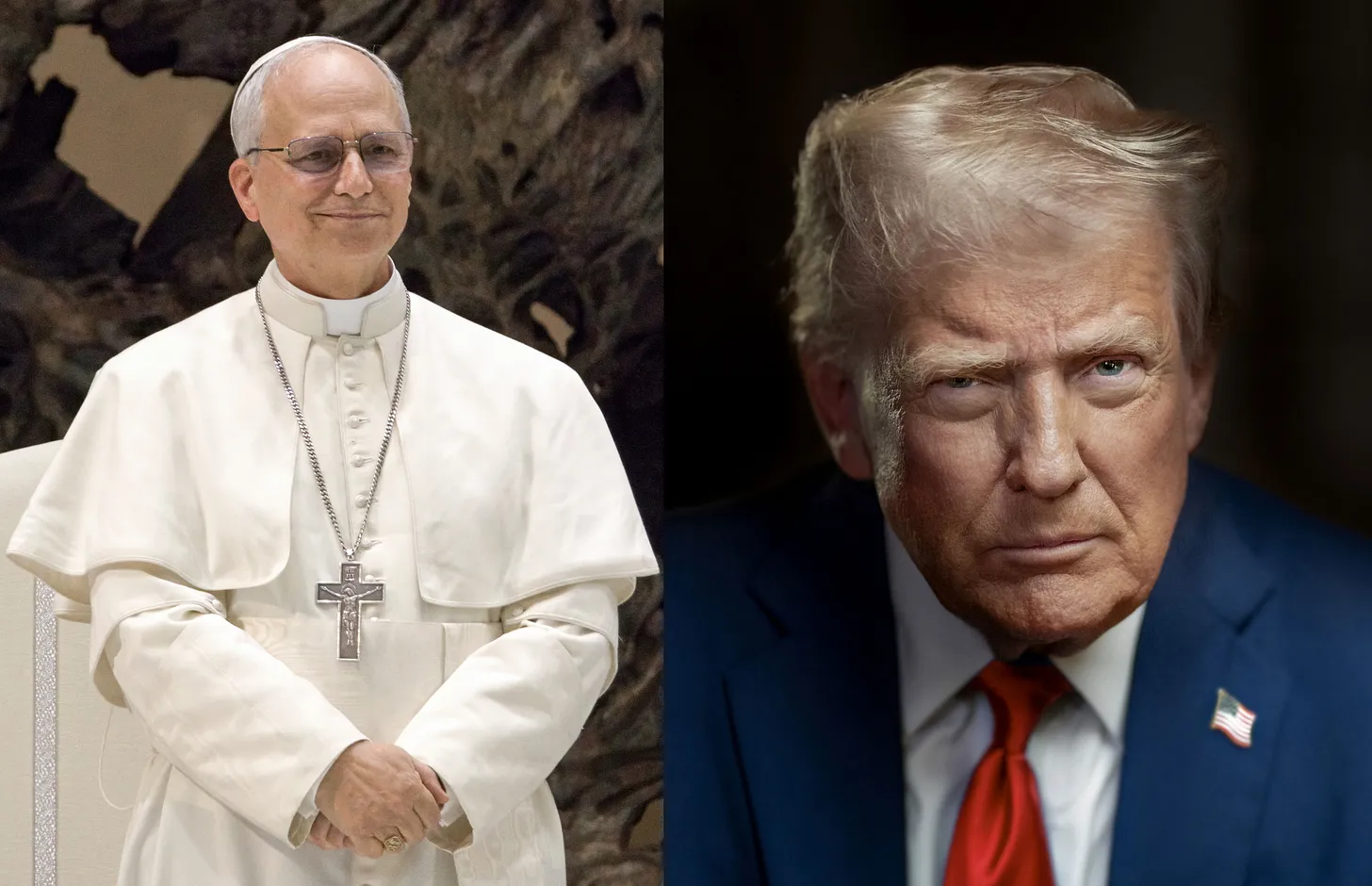
When the Pope quotes Scripture to question, albeit implicitly, the self-assumed righteousness of the American Secretary of Defence, something very odd is going on in the world. The President himself subsequently debated the Pope on morality, bizarrely attacking him as weak on crime. And the Vice-President, himself a Catholic, cautioned his pontiff about his theology.
Had you told the Founding Fathers that, at the eve of 250 th anniversary of the Declaration of Independence, the US government would be locked in a theological debate with the Papacy over its war in Iran, they would have dismissed it as a piece of wild invention. But here we are. And whatever else this moment is, it’s not secularisation as we have known it.
But the real contest isn’t between the Pope and the Trump Administration. It’s over Christianity itself — over whether the faith has a settled content that constrains how it can be invoked, or whether it has become a vocabulary available to anyone with the cultural confidence to claim it.
That contest matters well beyond Washington or Rome. It matters for any Christian trying to make sense of an increasingly unfamiliar cultural landscape, and for anyone who has noticed that Christian symbols, practices, and language now seems to be everywhere—circulating freely in public life—while being curiously detached from anything recognisably Christian in practice. We need to name what’s happening in order to distinguish it from simple secularisation.
We might call it post-Christian Christianity.
What post-Christian Christianity is—and isn’t
The term needs a little unpacking. For centuries, Western societies have been recasting ideas with distinctly Christian roots—for example, human dignity, care for the poor, the equality of all before God—as self-evident, universal truths. That process, described so well by Tom Holland in Dominion, was a kind of intellectual plagiarism: Christian convictions were reshaped, repurposed, and often detached from the doctrines that undergird them. If plagiarism is a form of flattery, then this has been a kind of backhanded tribute. Christian ideas endured because they couldn’t easily be discarded even by Christianity’s fiercest critics. In that sense, Western secularism has been defined in part by the ghosts of its Christian past.
Post-Christian Christianity moves in the opposite direction. It’s less concerned with Christian beliefs and doctrines than with the signs by which it is recognised. It understands the power of symbols and slogans in a crowded public square, and so it reaches for Christian language and imagery as instruments—useful, adaptable, and readily deployed in the service of political ends. Instead of Scripture shaping its vision of reality, a prior framework—often nationalist, or more loosely ideological—selects and selects and arranges Christian elements to support its own claims. Christianity, in this register, becomes primarily a branded resource to be exploited: less a faith to be lived than a rhetoric to be wielded.
Unmoored from its historical claims, Christianity becomes something like an floating signifier — a label that still carries emotional and cultural force, but no longer points to anything shared or settled. This isn’t the familiar pattern of denominational disagreement, where Christians differ yet remain accountable to a common inheritance. It’s more liquid than that, and more unstable.
That instability has a specific consequence. When a faith’s language floats free of its content, it can be invoked in one breath and contradicted in the next — without the contradiction registering as such. Public figures can speak of providence and divine favour while pursuing policies that trade deliberately on exclusion and performative cruelty. The dissonance doesn’t need resolving. It a performative badge rather than a constraint on moral behaviour.
This is something worse than hypocrisy. Hypocrisy at least acknowledges a standard it fails to meet. What post-Christian Christianity offers is a faith that can be displayed or performed without being inhabited — and that, in being displayed boldly, lends moral cover to exactly the kind of policies that Christian belief forbids. It’s not unlike how the word Democratic functions in in the Democratic People's Republic of Korea: authoritative and reassuring, but signifying the opposite of reality.
The shift, once named, is hard to un-see. Post-Christian Christianity functions less as a lived faith than a reservoir of images and phrases — its moral vocabulary detached from the tradition that generated it and redeployed wherever it’s useful. What remains isn’t a weakened Christianity but a different thing entirely: wearing the same name, drawing on the same inheritance, and increasingly indifferent — or hostile — to what that inheritance actually demands. It’s accountable to no authority it did not itself choose.
How this works in practice
When J. D. Vance invoked ordo amoris — the Augustinian “order of love” — to justify prioritising fellow citizens over foreigners, the Latin was doing at least as much work as the argument. The phrase came from a 2021 interview that resurfaced when he became Trump’s running mate and then Vice-President. Unfamiliar to most Christians, the terminology signals ancient authority and theological depth. Had he simply stated a preference for co-nationals, it would have sounded like politics. In Augustinian dress, it sounds like religious truth.
Vance is a professing Catholic, and ordo amoris is a real concept with genuine Augustinian roots — which is precisely what makes the move worth examining carefully. This isn’t a case of someone inventing tradition from scratch. It’s something subtler: a real idea, lifted from its context, and made to carry a point the tradition itself wouldn’t recognise.
Christian teaching has always acknowledged particular responsibilities toward those closest to us. Such attachments are part of the texture of ordinary love, not a failure of it. But they are the beginning of love, not its boundary. For Augustine, rightly ordered love starts with God and radiates outward; it’s always expansive. When asked who counted as a neighbour, Jesus answered not with a definition but a story: the Good Samaritan. Ordo amoris, rightly understood, knows no borders. It includes even enemies.
But Vance’s usage isn’t just a misguided interpretation; it’s conscription The technical label for a strand of Catholic teaching is lifted from its defining tradition not to extend or challenge it, but to claim its authority. What’s taken isn’t the doctrine but the prestige in order to signal a political position sound like a righteous claim. The result isn’t a reinterpretation of Christianity but its inversion. A faith built around the command to love the stranger and the enemy is recruited to justify their exclusion.
The same logic can also operate at a more purely visual register. When Donald Trump stood outside St John’s Episcopal Church in June 2020 — having cleared the square of protesters by force — and held up a Bible for the cameras, no text was cited and no tradition invoked. The symbol was simply brandished. What mattered wasn’t the book’s contents but its cultural charge. Trump’s stunt wasn’t simply a misreading of Christianity, but its appropriation as a prop.
Together, the two moments map the full range of post-Christian Christianity’s operation: at the level of doctrine and at the level of pure image, borrowing intellectual authority in one register and emotional force in the other. It’s equally at home in either. That’s precisely what makes it so difficult to counter.
A floating faith
Of course, Christianity has always attracted those who would bend it to their purposes. The Crusades were prosecuted in Christ’s name. Apartheid was given theological cover by the Dutch Reformed Church. Opposing armies in the First World War were blessed by chaplains on both sides. The history of Christianity is also, in part, a history of its co-option by power.
What made those abuses identifiable as abuses — and what made them contestable — is that they operated within a framework they were distorting. However badly the tradition was being warped, it remained the tradition: a shared body of teaching, practice, and authority against which claims could be measured and found wanting. The Crusades would later be criticised on Christian grounds. Apartheid theology was challenged, ultimately defeated, from within the Church itself. The arena was corrupt, but it was still an arena. Christianity retained enough institutional and doctrinal coherence to name its own betrayals. The old word for this was heresy.
What is happening now is structurally different. Post-Christian Christianity doesn’t distort the tradition from within — it operates outside it, selecting what’s culturally useful while discarding the rest, including any accountability to the tradition that generated it. This isn’t co-option so much as extraction: Christianity is mined for its emotional and symbolic resources, which then become the substance of post-Christian “faith.” Crucially, this faith must be performed rhetorically rather than inhabited obediently.
There was a time when the Church, in its various forms, acted as custodian of that framework. One could challenge it, reform it, or leave it, but bypassing it entirely while still claiming to speak for Christianity was difficult. That shared structure of authority has weakened considerably in recent decades — and the internet has accelerated its collapse. Social media allows anyone to assemble and broadcast a weaponised version of the faith, pieced together from fragments of Scripture, tradition, and cultural artefacts, without meaningful accountability to any community or tradition. Platforms reward the immediate, striking, and emotionally charged. They’re far less hospitable to the slow work of fidelity, or to the kind of serious, patient disagreement through which traditions have historically policed their own boundaries.
The result is a new kind of detachment. Christianity’s language, imagery, and emotional resonance can now be lifted and applied almost anywhere — the cross recast as a nationalist emblem, the language of spiritual struggle redirected into political conflict, crusaders and martyrs reinterpreted as symbols of civilisational strife. Often this owes more to popular culture and video games than to Scripture or theology. It can be deployed without being inhabited. And it’s telling that many who most visibly brandish Christian labels have little or no connection to the wider life of the Church. In fact, many regard the Church itself as part of the problem.
The Church’s own contribution
It would be easy to lay all of this at the door of political demagogues and social media influencers. But that would miss something more uncomfortable: the Church has played its own part, and we can only recover by naming it honestly.
For much of the twentieth century, the Church shared society’s confidence about where history was heading. The future was assumed to be more enlightened, more inclusive, more humane — and the Church’s task was largely to keep pace with it. When you’re convinced history is on your side, theological discernment gives way to accommodation. Secular assumptions get clothed in Christian language and presented as a prophetic voice.
The result was a Christianity increasingly shaped by its cultural surroundings — one that framed faith in terms of personal meaning, emotional fulfilment, and inner authenticity. As Karl Barth warned, when theology begins from human experience rather than God’s self-revelation, it risks becoming little more than an echo of its age. Doctrine yields to middle-class spirituality. And over time, the Church’s capacity to distinguish the Gospel from its counterfeits is dulled — until, as Stanley Hauerwas argues, a Church that has made peace with its surrounding culture finds it no longer has the coherence to form Christians at all.
Now that the future no longer looks self-evidently benign, many Christians find themselves confronting a world they didn’t anticipate and don’t know how to answer. What’s emerging in its place is harder, more volatile, and less hospitable to a safe and comfortable faith. A middle-class Christianity built around personal fulfilment and ethical niceness — one that asks little, costs less, and disturbs nobody — doesn’t have the tensile strength to respond to what’s coming. It’s too flimsy to bear the weight of the moment, and too undemanding to offer any real resistance to a post-Christian Christianity that’s neither nice nor comfortable.
Which makes the charge of inconsistency hard to brush aside. If the Church spent decades borrowing Christian language to lend weight to a largely middle-class moral programme, it’s in a weak position to object when others now do the same for different political ends. The habits are familiar, even if the content has changed.
Acknowledging this doesn’t mean collapsing all claims into equivalence — a Gospel that begins with the poor, the marginalised, and the meek doesn’t distribute its demands evenly. But it does mean that any serious response to post-Christian Christianity must begin with repentance rather than analysis, and self-examination rather than critique. We’re in need of the kind of ascesis that leads to the renewal of genuine faith.
The more faithful path
The temptation is to respond with a post-Christian Christianity of our own that’s more congenial to our politics, more flattering to our instincts, more comfortable to inhabit. But that’s just to join the competition for empty signs. It’s to fight dissolution with more dissolution.
The harder path is slower and less visible. It’s to recover Christianity as something with genuine content — with practices, discipline, and doctrinal form that demands something of us. That requires not only clearer teaching but an ecclesial authority that’s actually exercised: one that forms as well as instructs, that binds as well as persuades. Doctrine must function not as commentary on life but as its governing grammar within the visible community of the Church.
A faith that demands nothing offers nothing. It hasn’t the resources to contest a post-Christian Christianity that’s emotionally coherent, culturally fluent, and entirely clear about its aims. To meet that, the Church needs to recover what comfortable Christianity has surrendered: the strangeness of the Gospel, the cost of its demands, and the seriousness of belonging to a community accountable to something beyond itself.
That means being a place where repentance costs something, where forgiveness isn’t just a nice sentiment, and where love of neighbour stretches beyond comfort, affinity, and agreement to include even enemies. It means recovering a Christianity that’s not simply performed but inhabited, that makes demands on the body, on the diary, on the wallet, and on our deepest desires.
Because a Christianity that asks nothing in return has nothing left to give. It can circulate endlessly — in speeches, on banners, across feeds — and mean less with every appearance. The question isn’t whether Christian language will continue to be spoken. It will. The question is whether there will be a Church that still knows what it means — and that is itself the answer.