Adoration in Eastern Catholic rites
Clipped from: https://perpetualeucharisticadoration.com/adoration-for-eastern-catholic-churches/
By
Table of Contents [hide]
- 1 Adoration is One of the Four Ends of Every Divine Liturgy/Mass
- 2 Rites of the Catholic Church
- 3 Syro-Malabar Catholics have Adoration with Exposition of the Blessed Sacrament
- 4 Melkite Rite Catholics have Adoration with Exposition
- 5 Maronite Rite Catholics with Daily Eucharistic Adoration with Exposition
- 6 Adoration for Byzantine Catholics
Adoration is One of the Four Ends of Every Divine Liturgy/Mass
Adoration is one of the four ends or intentions of every Divine Liturgy (Mass) in all Catholic rites: adoration, reparation, thanksgiving, and intercession.
“It is this Real Presence, and the witnessing to it that inflames every page of the Gospel. At the birth of Christ, nothing could blind the inner eyes of the evangelists from seeing invisible realities, and penetrating the Real Presence.”—Eastern Catholic Archbishop Joseph Raya
See: The Eastern Rite Catholic Church, article by Fr. William Saunders, from the Catholic Education Resource Centre
“While adoration is universal, Eastern traditions emphasize its liturgical dynamism (CCC 1378).

Rites of the Catholic Church
| Rite | Particular Churches Sui Iuris |
|---|---|
| Alexandrian | Coptic, Ethiopian, Eritrean |
| Armenian | Armenian |
| Byzantine | Albanian, Belarusian, Bulgarian, Croatian/Serbian, Greek, Hungarian, Italo-Albanian, Macedonian, Melkite, Romanian, Russian, Ruthenian, Slovak, Ukrainian |
| East Syriac | Chaldean, Syro-Malabar |
| Latin | Latin Church |
| West Syriac | Maronite, Syriac, Syro-Malankara |
Syro-Malabar Catholics have Adoration with Exposition of the Blessed Sacrament
The Syro-Malabar Catholic Church is one of the 22 Eastern (Oriental) Catholic Churches in full communion with Rome. It is the second largest Eastern Catholic Church after the Ukrainian Church and the largest of the Saint Thomas Christian (Nazrani) denominations with 4.6 million believers.
Syro-Malabar congregations have been celebrating their Divine Liturgy in some Latin rite churches. They have a rich tradition in a language of India, Malayalam. A number of the faithful and their priests visit the parish adoration chapel after Mass in the parish. Syro-Malabar congregations are among the most faithful adorers, covering many hours of exposition through the week including nights.
They can often be seen prostrating completely before the Blessed Sacrament, or walking up the aisle of the church on their knees. They are lovely people and have many daily communicants attending the Roman rite Masses as well.
“The Syro-Malabar Catholic Church stems from the Syriac spiritual tradition following the East Syrian liturgical rite rooted in the ancient Christian community of Edessa (Syria).” Syria, in Kerala, where the Syro-Malabar rite is practised, the faith was first brought there by St. Thomas the Apostle. They have exposition in a Monstrance. Source: Catholic Voice Oakland
Above video: Adoration with exposition in the Syro-Malabar rite. The youth seem to be having a good time. While others adorers may spend most of their time in silence in adoration.

Melkite Rite Catholics have A****doration with Exposition
The Melkites: ‘A bridge between Rome and the Orthodox world’: “The Greek Melkite Catholic Church, which has been in full communion with Rome since the 18th century… A Byzantine rite church, it has 1.3 to 2 million followers in the world, mainly originating from Syria and the Holy Land.”
Melkite Rite of Benediction of the Most Blessed Sacrament
Maronite Rite Catholics with Daily Eucharistic Adoration with Exposition
“The Maronite Monks of Most Holy Trinity Monastery are a Catholic community of contemplative monks dedicated to a life of prayer and Eucharistic Adoration—a life of religious reparation and penance for souls—that is, for our brothers and sisters in the world, especially those in most need of our prayers. We are a cloistered, contemplative community in which there is an harmonious fusion of cenobitic and eremitical living. This life of adoration and penance overflows to others by making possible to all God’s People in the local community the opportunity for: Adoration of the Blessed Sacrament, Sharing in the Liturgy of Divine Office, Participating in the Divine Liturgy of the Mass.” (Most Holy Trinity Monastery, 67 Dugway Road, Petersham, Massachusetts 01366)
Adoration for Byzantine Catholics
Eastern rite Catholics have great devotion to Our most holy Mother of God (“Theotokos” in Greek and “God-bearer) including in their Divine Liturgy.

In Eastern Byzantine-Ukrainian Catholic churches, the Blessed Sacrament is venerated during the Divine Liturgy even by those who are not receiving Communion. When the deacon brings the chalice out before the Communion of the Faithful, all either make a full prostration or bow, depending upon the day.
A second veneration may also be said to take place after Communion when the priest elevates the chalice before taking it to the Table of Oblation. Also, at the Liturgy of the Presanctified Gifts, during the Great Entrance, as the priest carries the chalice and diskos (paten) to the Holy Doors, everyone prostrates themselves in veneration before the consecrated Gifts.
One can spend time in adoration of the Blessed Sacrament before the Tabernacle, usually made in the form of a little church or in the form of a dove suspended over the Altar. There is much reverence and the icons and a quiet atmosphere in Eastern churches make for wonderful times of prayerful adoration and contemplation.
Theologically speaking, the faithful are called to adore the Gifts whenever and wherever they are present, including outside of the time of the Divine Liturgy.
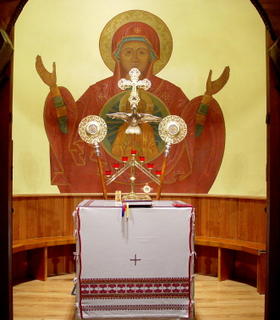
“Ordinarily you will find a tabernacle on the Holy Table. (I prefer ‘tabernacle’ to the Greek artophorion, simply because it is more meaningful. Artophorion literally means ‘bread-bearer,’ while tabernacle means ‘dwelling place.’ One means a holder for something, while the other means a place where some One resides—though of course the faith is the same in both traditions.) Usually the tabernacle is made in the form of a little church, but occasionally you will find (as you do in our monastery) a tabernacle in the form of a dove suspended over the Altar. This works from a practical standpoint by keeping clear the already limited space on the Holy Table, but more important is its symbolism. It reminds us that it is the Holy Spirit through whom the gift of the Holy Eucharist is given to us; by the power of the Spirit the miracle occurs. ‘…send down Your Holy Spirit upon us and upon the Gifts here present. And make this bread the precious Body of Your Christ. Amen. And that which is in this chalice the precious Blood of Your Christ. Amen. Changing them by Your Holy Spirit. Amen, amen, amen!’ (from the epiclesis).”
Source: New Liturgical Movement
The following is taken from: St. Michael’s Byzantine
Prayer “Before Communion
“The following prayer is recited by the faithful at Divine Liturgy (Liturgy of St. John Chrysostom; Liturgy of St. Basil the Great) prior to reception of Holy Communion (Eucharist).
“This prayer is a profound declaration of our belief in Jesus Christ and His Real Presence in the Eucharist.
“It is also a prayer of humility and repentance before God, expressed with contrite petitions for forgiveness and mercy.
O Lord, I believe and profess that you are truly Christ,
The Son of the living God, who came into the world
To save sinners of whom I am the first.
Accept me today as a partaker of your mystical supper, O Son of God,
For I will not reveal your mystery to your enemies,
Nor will I give you a kiss as did Judas,
But like the thief I profess to you:
Remember me, O Lord, when you come in your kingdom.
Remember me, O Master, when you come in your kingdom.
Remember me, O Holy One, when you come in your kingdom.
May the partaking of your Holy mysteries, O Lord,
Be not for my judgment or condemnation,
But for the healing of my soul and body.
O Lord, I also believe and profess, that this,
Which I am about to receive,
Is truly your most precious Body, and your life-giving Blood,
Which, I pray, make me worthy to receive
For the remission of all my sins and for life everlasting. Amen
O God, be merciful to me, a sinner.
O God, cleanse me of my sins and have mercy on me.
O Lord, forgive me for I have sinned without number.
“Preparation of bread and wine for Holy Communion in the Byzantine Catholic Church
“The priest prepares the holy gifts of bread and wine on the Table of Preparation or Oblation, a side altar to the left of the main altar behind the icon screen. This very special part of the liturgy is called the Liturgy of Preparation (or also Proskomedia). It happens before the main part of the Divine Liturgy.
“The priest prepares the bread (prosphora) for Holy Communion. It is a small round leavened loaf stamped on the top with a square seal: a cross surrounded by the Greek letters IC XC NI KA. The letters stand for Jesus Christ conquers. The priest cuts the square portion of seal using a symbolic liturgical spear. This cut portion is called the Lamb. In addition to saying prayers based on Scripture during this entire initial part of the liturgy, the priest prepares other portions of the prosphora that are cut and arranged symbolically in a specific pattern on a diskos (liturgical plate). These include: a small triangular portion in honor of the Blessed Virgin Mary (Theotokos); nine particles in honor of the heavenly hosts and other particles commemorating members of the church and faithful, both living and dead. The Lamb together with all the particles represent the Universal Church and Kingdom of God. The liturgical wine is also prepared with a small amount of water added to symbolize the blood and water that flowed from the side of Christ on the cross when he was pierced by a soldier. The diskos and chalice are covered with liturgical cloths. During the part of the Divine Liturgy called the Great Entrance the gifts are blessed again with incense and in procession with the deacon and altar servers, brought to the main altar by the priest.
“The prepared gifts are consecrated during the part of the Divine Liturgy called the anaphora. The priest says the words of Institution that Christ spoke during the last supper with his apostles (“…do this in remembrance of Me”). In the Byzantine Catholic church, the transubstantiation is completed during the epiclesis, the prayer in which the priest invokes the Holy Spirit to change the elements of bread and wine to the actual Body and Blood of Jesus Christ. This is the most solemn and holy part of the Divine Liturgy.”