Modern sacred art with pre-modern visual and theological instinct
Clipped from: https://hilarywhite.substack.com/p/modern-sacred-art-with-pre-modern
By Hilary White
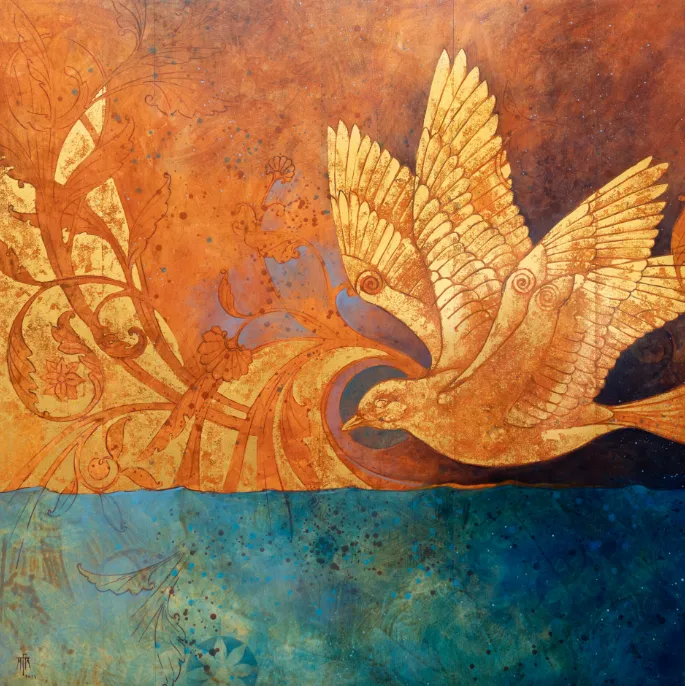
“Premier jour” (“First day”) Augustin Frison-Roche. 2024. Oil on wood panel. Part of his series on the days of creation.
I’m on my way home after 11 days in Aberdeen, South Dakota, to Narni in Umbria. A long way, and I’m writing this from Minneapolis airport, on one of my two long lay-overs suspended between continents, between realities, floating in an odd high-tech netherworld, a sort of chrome and neon Wood Between the Worlds, watching planes lift like steel whales into a pale and chilly Midwestern spring sky. I’m here amidst this, thinking about ancient gardens and mystic apparitions, art in which worldly and divine realities meet. So I thought we could take a look together at one of my favourite contemporary sacred artists. It feels oddly appropriate. I should write in airports more often.
I’m using the airport’s high speed wifi, and am closed into my own little world, wearing noise-cancelling wireless bluetooth headphones, listening to a downloaded playlist on Spotify. I found my departure gate by riding a monorail, and I just bought a universal power adaptor for my laptop from an electronics vending machine. Yeah…
Now where’s my flying car and robot maid?
In a place like this - this palace of Modernia - my inner visual world is turning over this wild, vast contrast between the ancient and the modern world. That old world that is so much in evidence every day in antichissimo Narni as well as in the work of the French painter Augustin Frison-Roche.

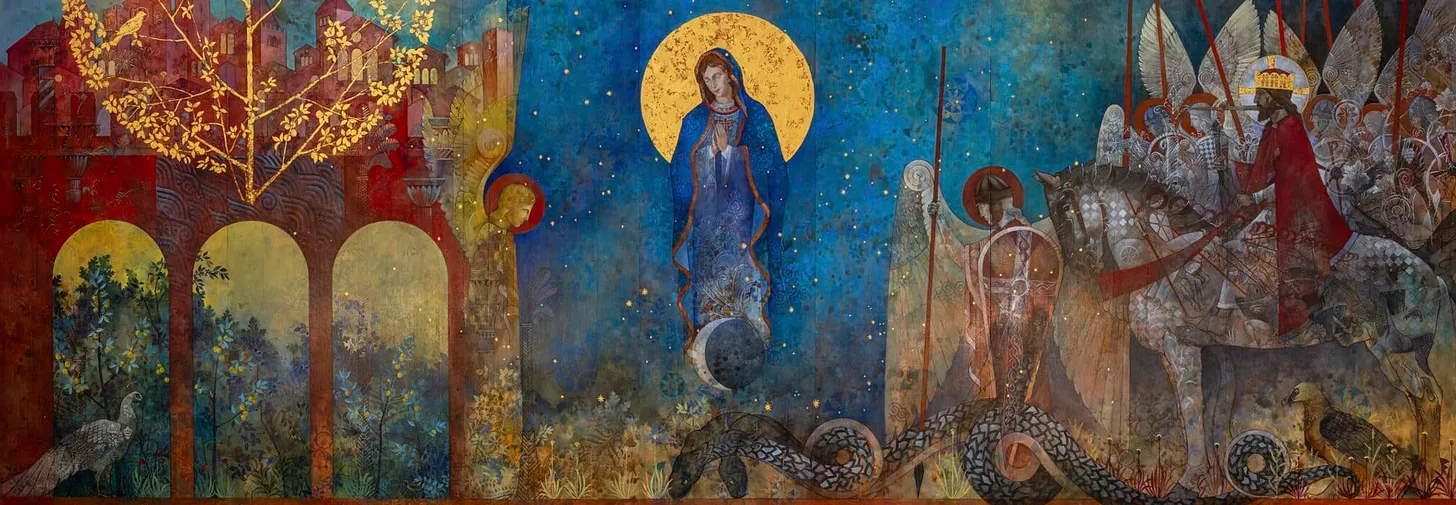
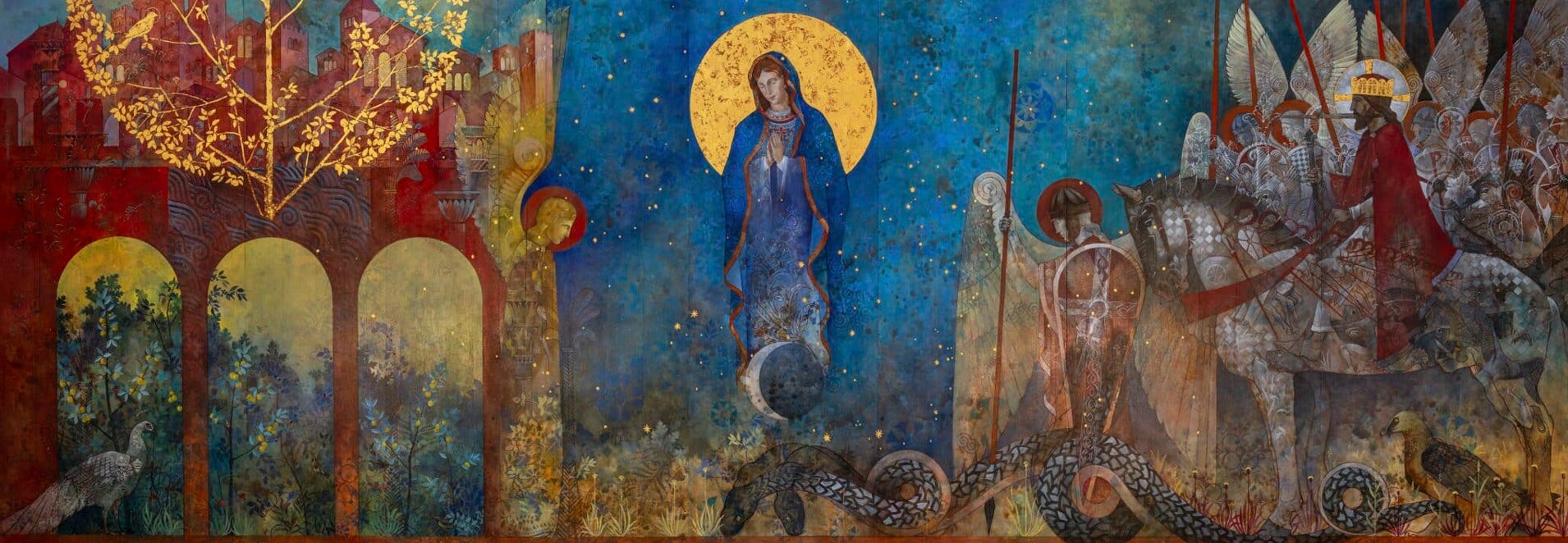
Apocalypse 2020
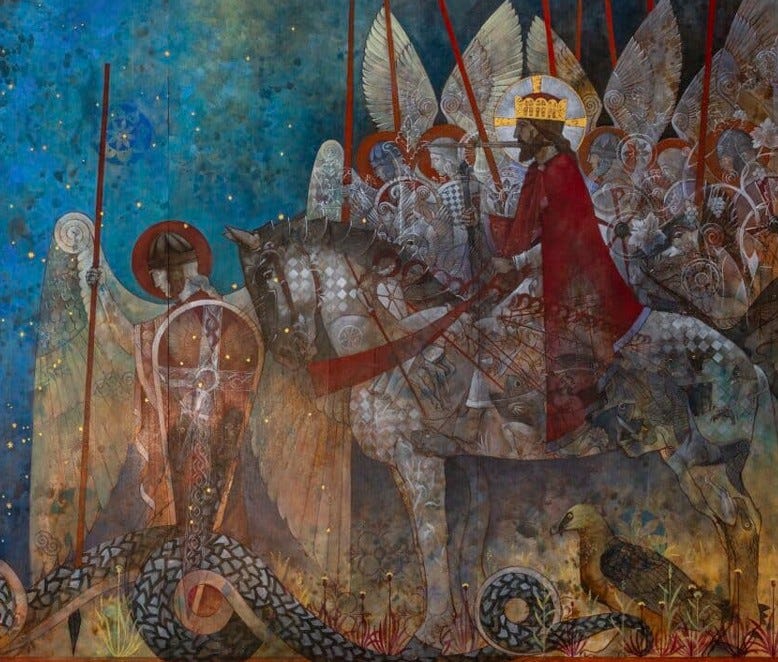
“Premier jour” (“First day”) Augustin Frison-Roche. 2024. Oil on wood panel. Part of his series on the days of creation.
In today’s post for all subscribers, we will look at the landscape and religious painting of contemporary painter Augustin Frison-Roche. These works build a deeply chromatic, layered mystical world by directly manipulating the surface materials rather than giving in to the temptation to depict an illusionistic depth of space. We’re not supposed to imagine stepping through a window, but rather to be immersed in this iridescent world. Trees are heavy with mystical and symbolic fruit or flowers, figures drawn from Scripture and myth are seen in a clearly medieval western iconographic style. His paintings show us the connection between divine reality and the natural, material world expressed directly in the paint and gold.
Augustin Frison-Roche’s religious art
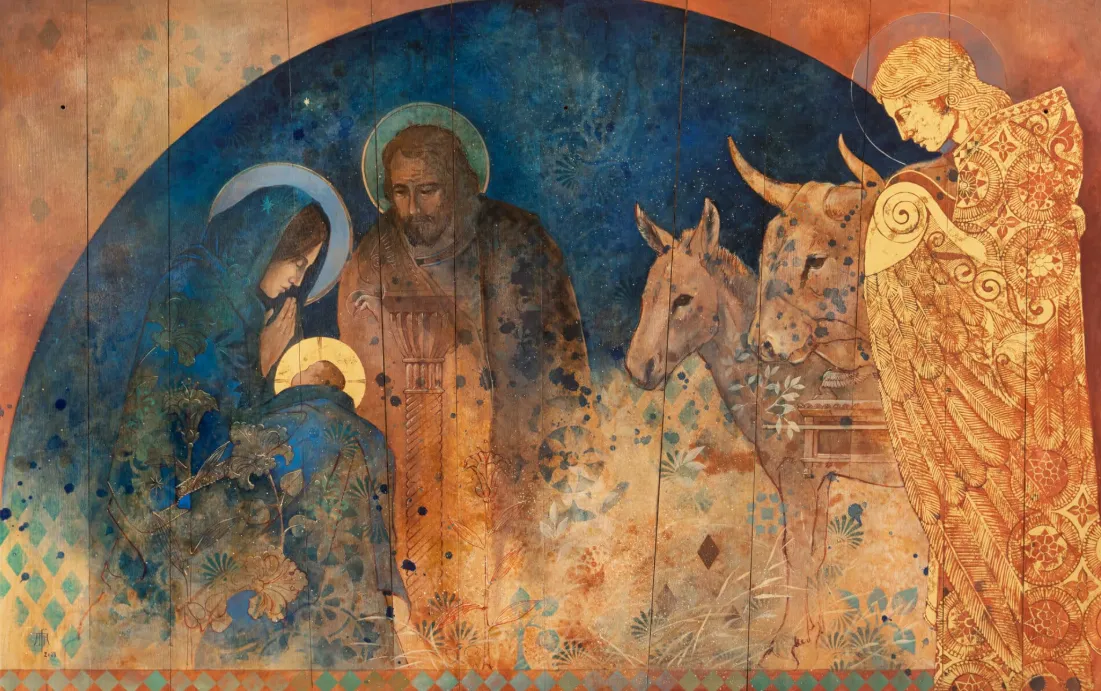
Nativity. It contains all the universally recognised iconographic elements. He paints mainly in oils on wood panels.
Frison-Roche’s religious paintings are where his deep religious imagination really shows with unmistakably iconographic figures, in keeping with all our previously mapped-out aspects: frontal, symbolic, canonical, still and hieratic.
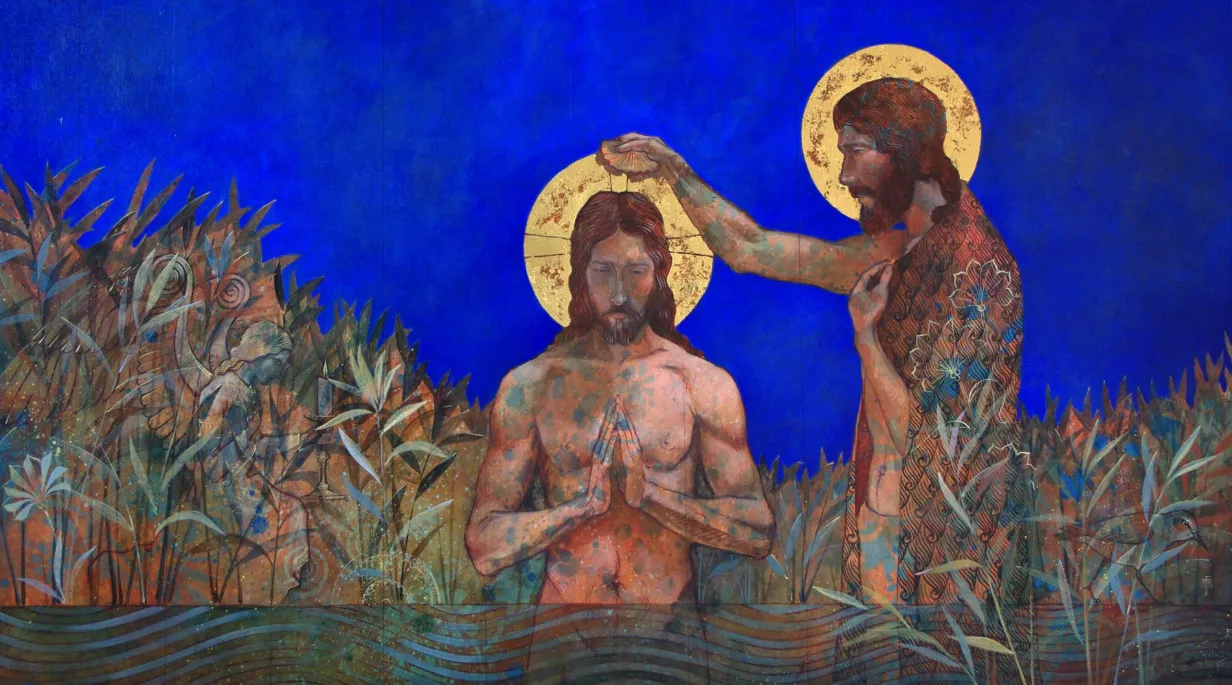
“Baptism of Christ” That blue! And the symbolic lines showing the water of the Jordan river.
His surfaces are deeply layered with colours that juxtapose translucent, delicately layered texture and intensely saturated single hues. These surfaces feel almost like that “loose watercolour” style (that’s much more difficult to master than it seems) where the paint is allowed to run together and bloom, with splatters and multiple colours merging into one another. Yet it never becomes messy or accidental, his colours retaining their character and never becoming muddy. And the the entire field, apparently chaotic, is steadied by repeating patterns, controlled ornamental motifs created with strictly edged and stenciled forms that give the compositions rhythm, structure and clarity in the midst of all this organic natural texture.
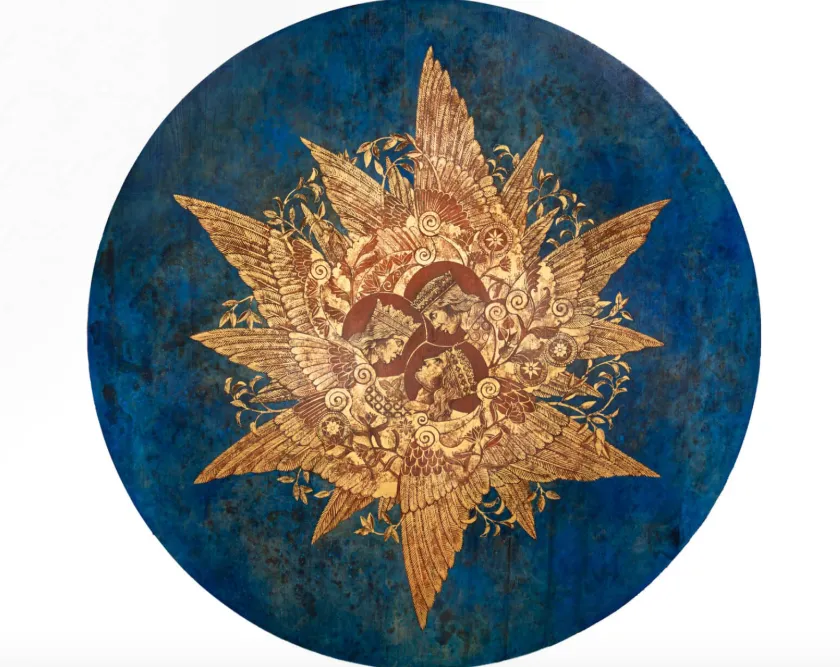
“ L’Etoile ” (“The Star”) 2024
Faces and figures are simplified, even abstracted, and withdrawn from modern expressions of psychology or emotion. Halos are the recognisable traditional mathematically precise circular nimbus, not vague atmospheric glows. Wings are patterned and rhythmic. Nothing is sentimental, there’s no theatricality or appeals to emotion.
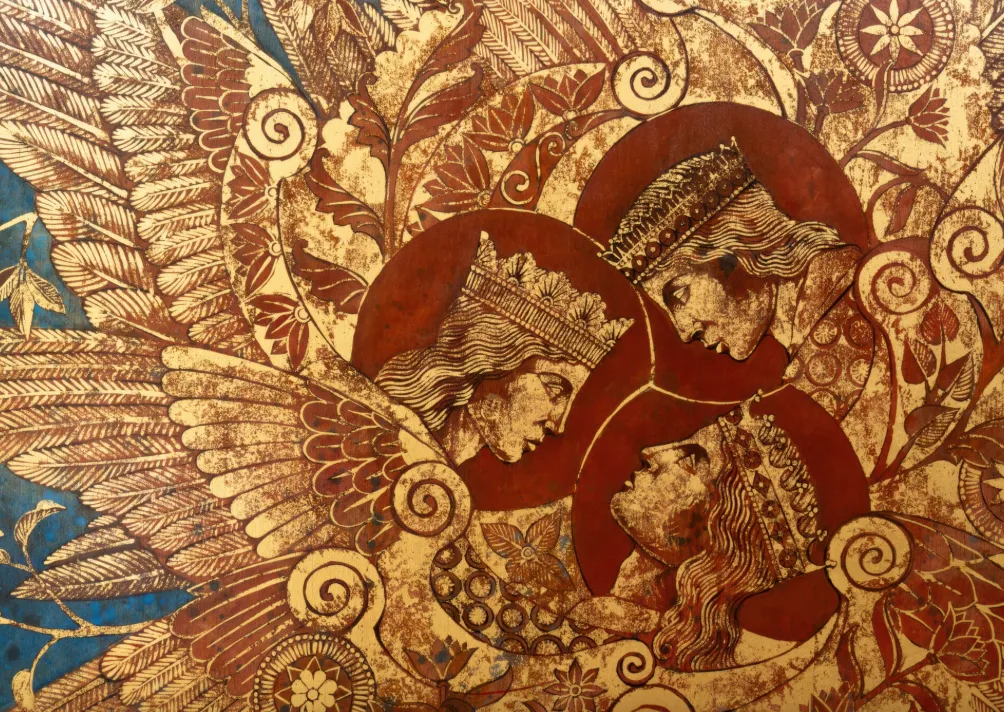
L’Etoile (detail) - the perichoresis of the Trinity depicted as the Star of Bethlehem. The halos form a traditional geometric symbol for the Trinity, the Persons of which are depicted as visually identical, in keeping with the medieval western custom.
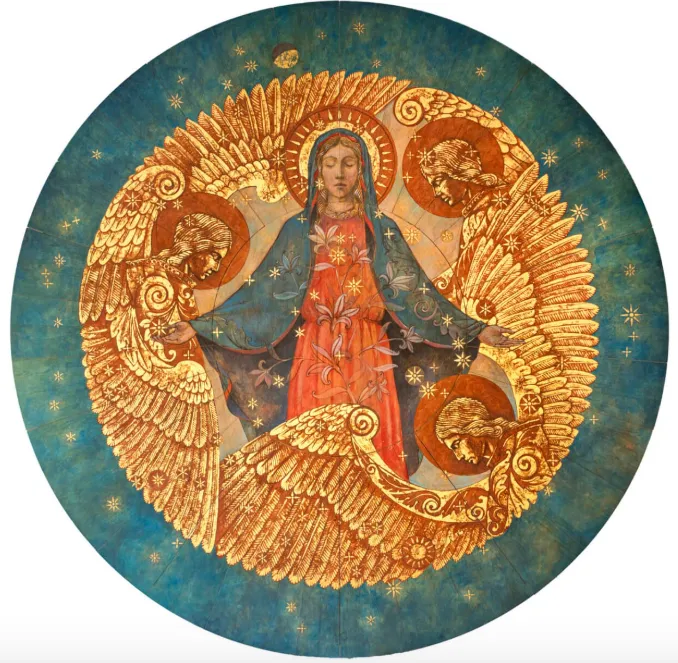
L’Assomption
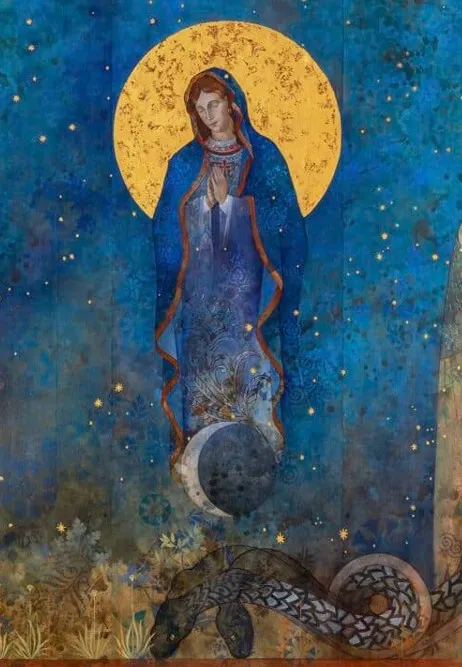
While he’s using the ancient traditional forms, both Byzantine and western medieval prototypes, his use of pattern and abstraction presses right up against, and blends around the edges, with naturalistic figuration and textures. We instantly recognise the “Woman clothed with the sun” from Revelation. We know the angels and the Holy Ghost, but it’s all handled through a mastery of modern and ancient colour and materials.
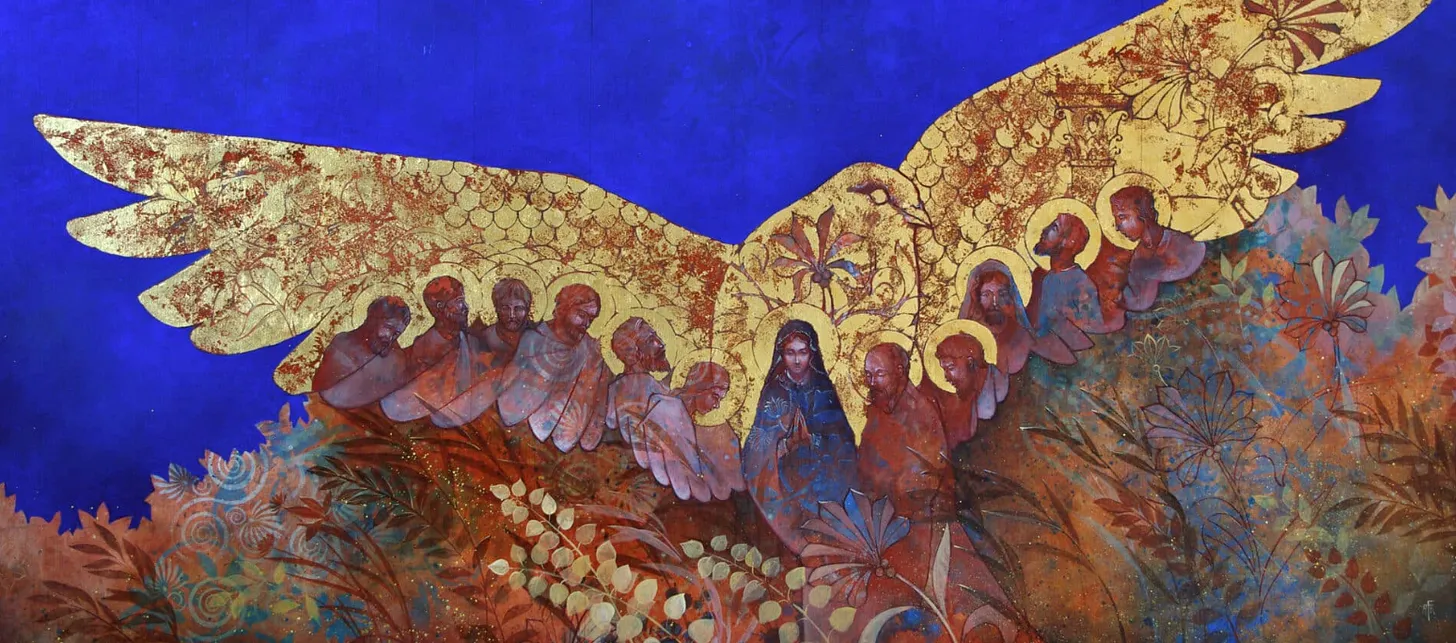
Pentecost. The Ultramarine blue that was prized by western painters for its intensity and a strange feel of being lit from within, contrasting perfectly with the gold over a red ground.
It feels like he completely understands what sacred signs are for, and refuses both Gothic or Renaissance naturalism and modern ironic detachment.
Of course, what strikes the viewer immediately and most powerfully is the absolute mastery of colour. The blues are not there to mimic the natural atmospheric sky. These are dense, incredibly intense mineral pigments, ultramarine - the classic medieval colour used to symbolically depict the heavenly realm.
He uses gold as well as paint to indicate light in an iconographic way, not falling from a single directional source. As in formally canonical icons there are no cast shadows to indicate depth of space. Instead, illumination seems to come from everywhere at once, from the gold ground, from the surrounding colour fields, even from within the figures themselvess. It’s a very old solution to the problem of light that, while refusing naturalism, treats light as both a theological condition and a physical phenomenon.
A timeless dreamworld - nature elevated
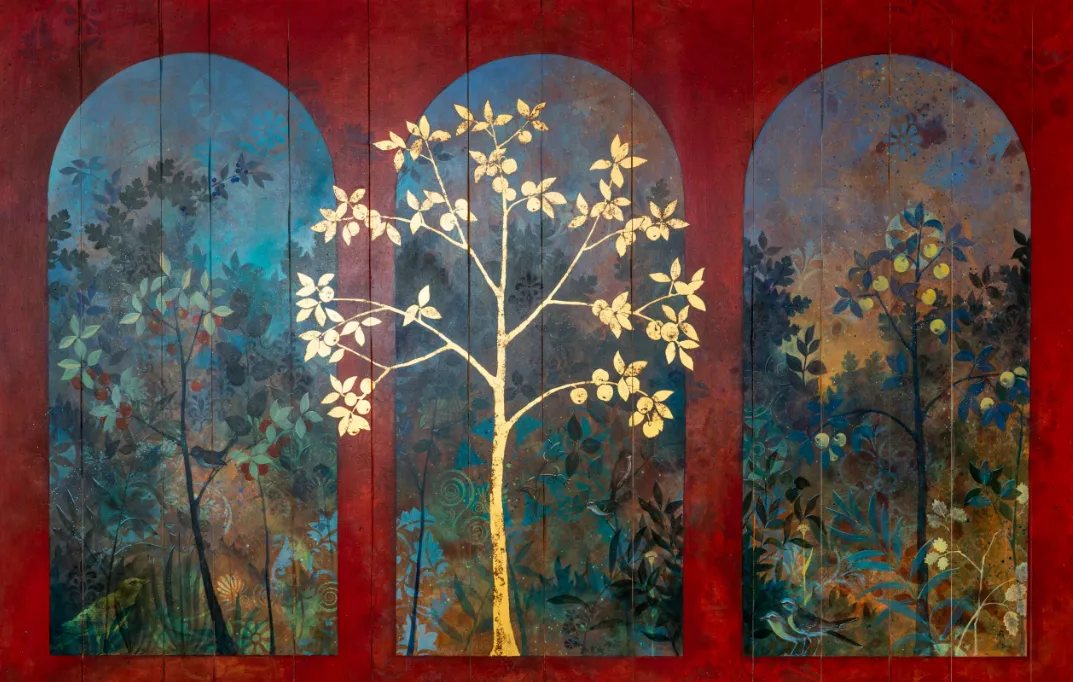
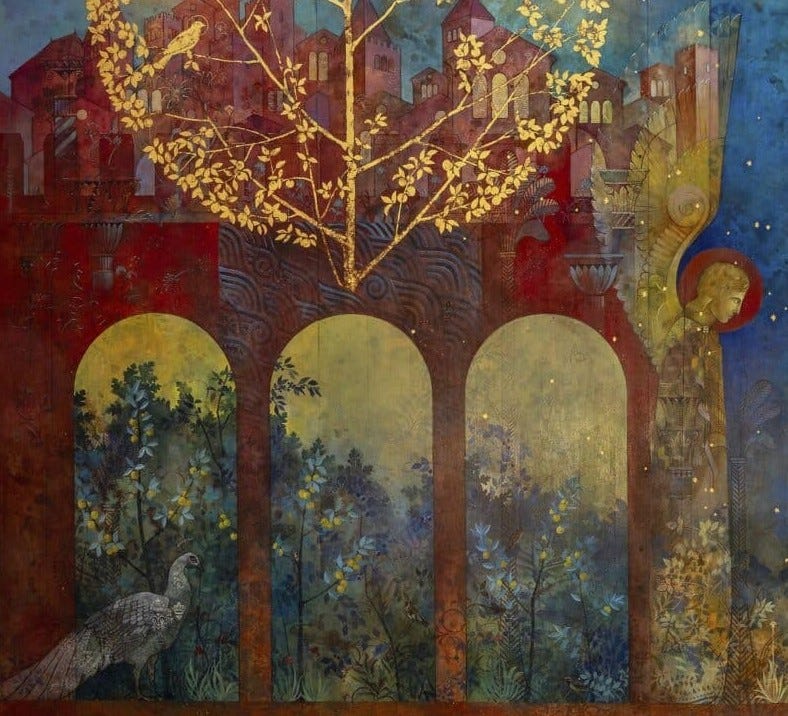
Paradise. 2020
But his genius lies in combining these traditional elements with an eye for natural, random beauty of the plant and animal world - especially evident in his series on the days of creation.
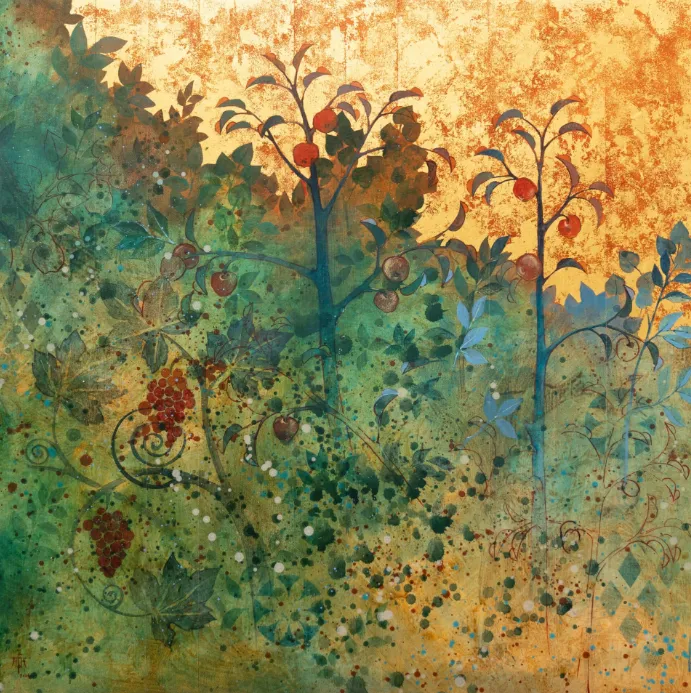
“ Troisième jour ” (“Third Day”) Augustin Frison-Roche. 2024
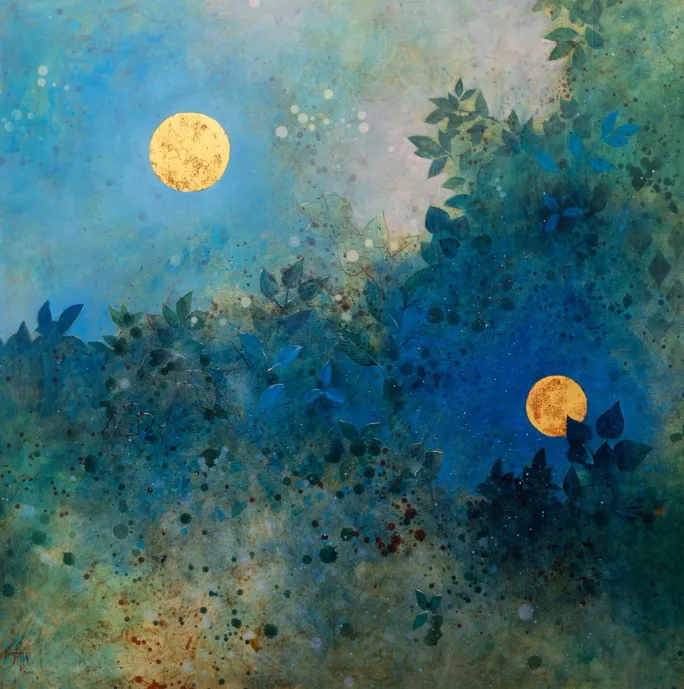
“ Quatrième jour ” (”Fourth Day”) 2024. Absolute mastery of colour theory; indispensable for this kind of work.
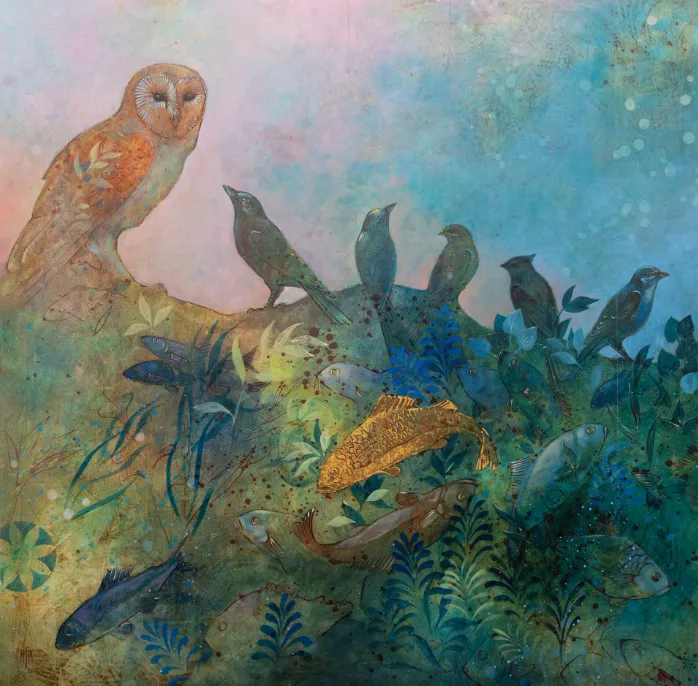
“ Cinquième jour ” (“Fifth Day”) 2024 - notice how he’s handled the highlights on these corvid birds (grackles, maybe?) where they are picked out and the form completed and rounded with just a few strokes of light.
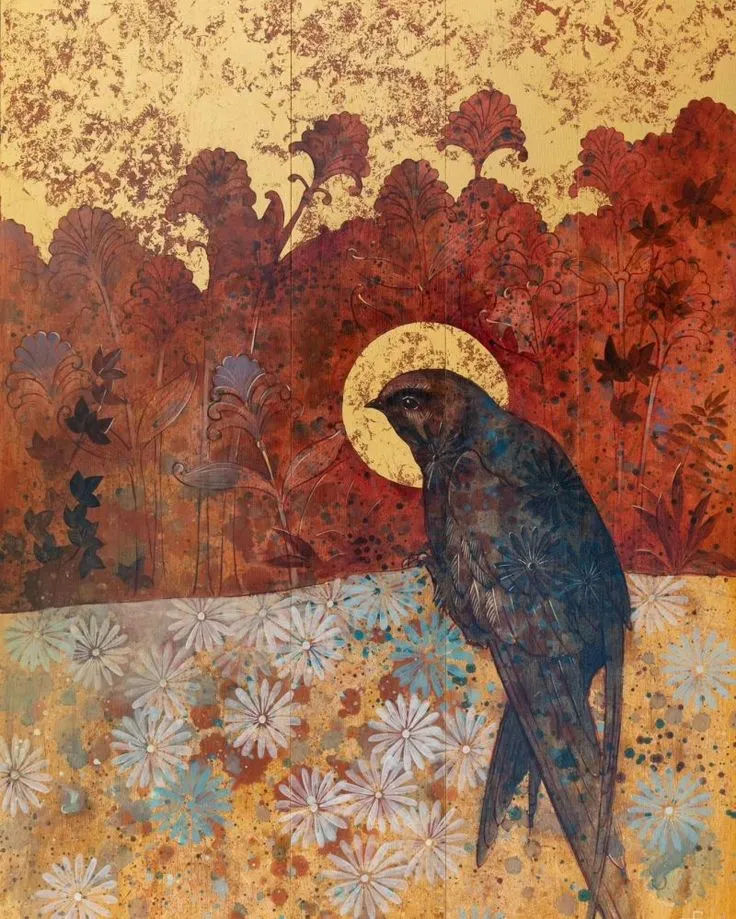
“ Winged Messenger” - The swift or swallow is one of the birds typically used in the middle ages to depict the Holy Spirit. His animals The animals function as medieval religious symbols but they are not reduced to heraldic emblems. He paints them with enough natural observation that they retain weight and physical presence. This is very much in keeping with the manuscript tradition where creatures are recognisable and at the same time carriers of theological meaning.
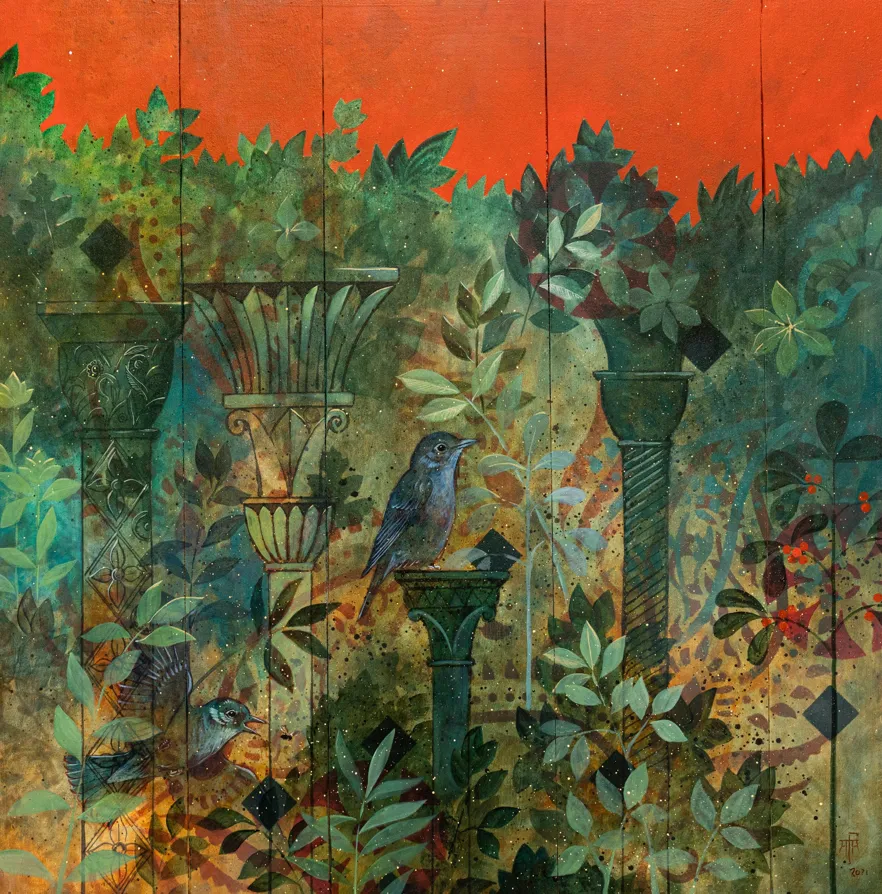
La Nature est un temple 3. 2021
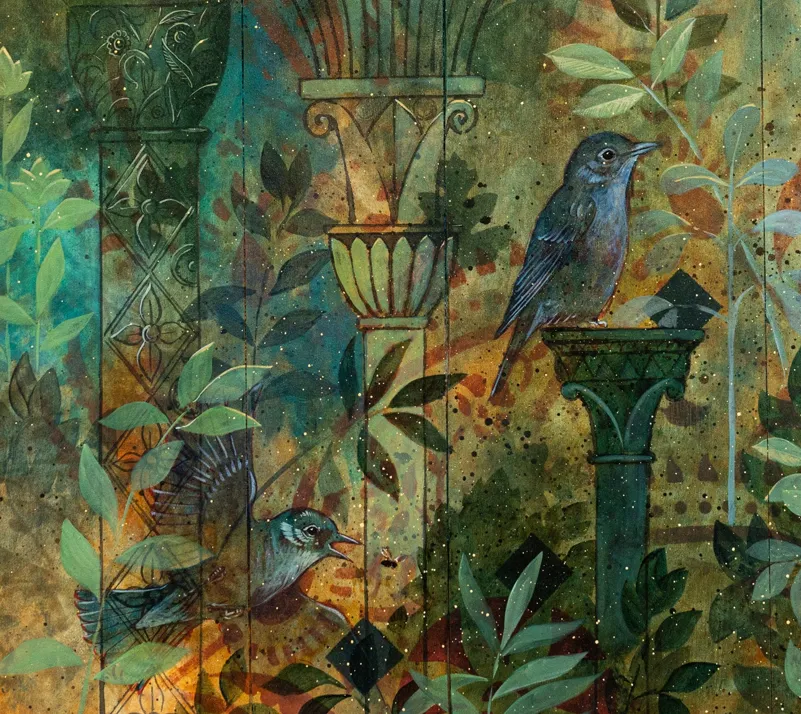
The first thing I thought of when I saw these dreaming, jewel-like landscapes, was the decorative frescoes of the famous “garden room” of the House of Livia in Rome.
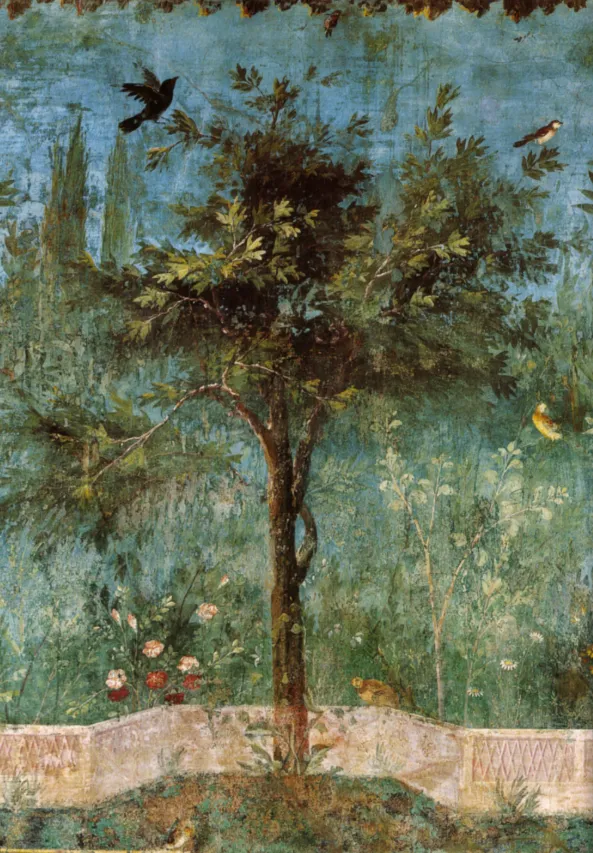
The Villa of Livia is a preserved Roman house about 12 km outside the centre of Rome, traditionally linked to Livia, the wife of Emperor Augustus, and thought to have been her country residence.
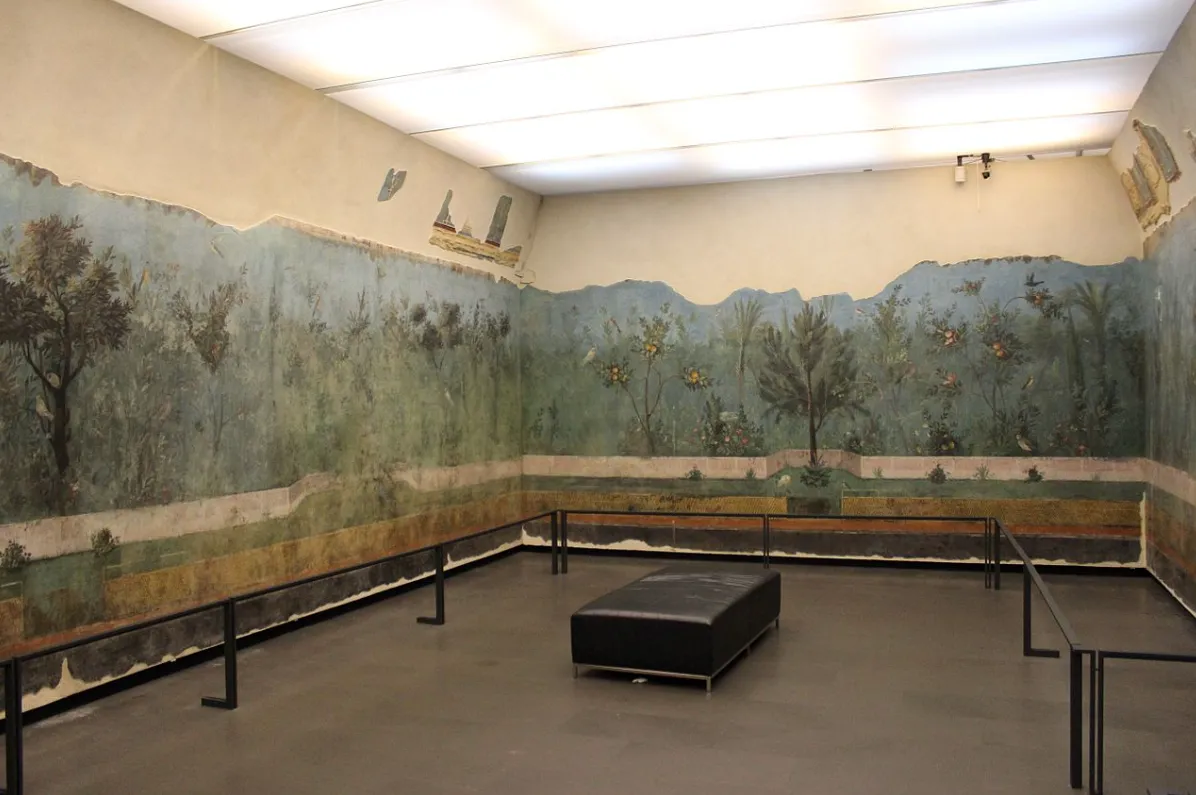
The villa is best known for its astonishingly well preserved garden frescoes (that have been moved to a museum), wall paintings that seem to dissolve into a misty natural paradise, a painted orchard and fragrant garden, with trees, birds, flowers, fruit and animals.
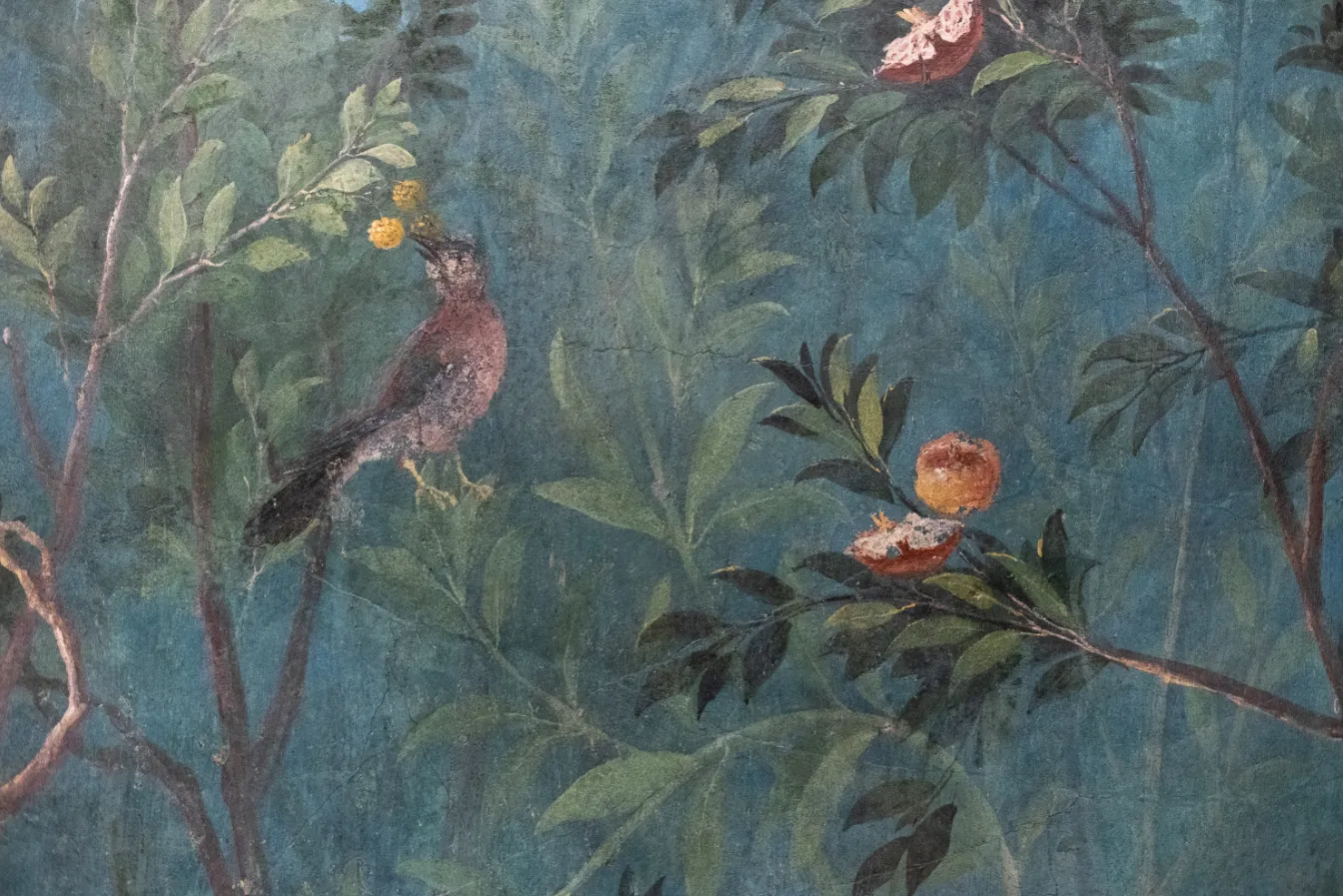
In these, we see the same idealised natural world. We are not looking at an attempt to recreate “real life” as the eye sees it. The vegetation does not behave as landscape one can climb into, in the later Renaissance sense. It exists in a suspended decorative field: flattened, layered, rhythmically repeated but still naturally randomised, simultaneously natural and stylised. Space is suggested but never fully constructed in mathematical perspective, it is allowed to remain in a mysterious distance. It’s a garden of the divine imagination.
The painter
He is a French painter and sculptor based in the Lot-et-Garonne. He began drawing at age 15, studied literature and history and then spent three years training in painting in the studio of François Peltier.
His website has a full gallery. Visit here.