Eucharistic Doctrine in the Church of England: 1534-1934: An Overview
Clipped from: https://anglicanway.org/eucharistic-doctrine-in-the-church-of-england-1534-1934-an-overview/
By Peter D. Robinson
Eucharistic Doctrine in the Church of England 1534-1934: An Overview
by
Had you walked into an English parish church in time for mass in the 13 th year of the reign of King Henry VIII, the sight which would have greeted you would have been a congregation who were very largely spectators to the miracle of the mass. There would have been a few of the new-fangled pews, and parts of the nave would have been screened off to provide chantry chapels. Most of the parishioners stood or knelt in the open interior. The nave walls would have been covered with scenes from the Bible and the lives of the saints, the windows would have glowed with stained glass, and the east wall of the nave, above the figures of Christ crucified, Our Lady, and St John would have been filled with the Doom, the last judgement. The Eucharistic action itself would have been barely visible. In most churches, a large wooden board filled the top of the chancel arch and acted as a backdrop to the figures of the Rood, Our Lady, and St John, which were illuminated by candles provided by the votive offerings of the parishioners. The rood screen itself would have been painted with the saints and provided with gates. Within, the celebrant and his assistants would have undertaken the ritual of the mass – all in Latin, apart from the Bidding of the Beads after the Creed. The air would have been filled with incense and plainsong, with the congregation disturbing their private devotions only to observe the elevations which accompanied the words of institution, little realizing that this central ceremony of the mass was only about three hundred years old at the time. They were there to witness the miracle of the mass, the transubstantiation of bread and wine into the actual body and blood of Christ, the all-availing sacrifice, which remitted sin and released souls from Purgatory.
If you had gone into that same church fifty years later, in the 13 th year of the reign of Elizabeth I, things would have been vastly different. The old doctrine of the mass had been condemned as ‘repugnant to the plain words of Scripture’ and its ceremonies abolished as being contrary to Christ’s ordinance, and the interior of the Church reflects this. The mass had become ‘The Administration of the Lord’s Supper or Holy Communion’ at which ‘some at least’ were expected to receive with the priest Sunday-by-Sunday. However, nearly a thousand years of infrequent communions meant that that the priest only got the necessary ‘quorum’ for the Lord’s Supper once a month, or less, and on the other Sundays the service was read as far as the end of the Prayer for the Church, a collect or two were added, and then the priest dismissed the congregation with the blessing. As you looked about the nave, the wall paintings were gone, replaced by text painted on the walls. Some superstitious images had been removed from the stained glass, but in the main, the windows survived – as glass was expensive and churchwardens were cheap. The doom was gone, and so was the rood loft. The screen had survived, shorn of its gates, whilst the tympanum above it now served as a convenient place to display the Ten Commandments and the Royal Arms. The chancel was now empty apart from the old stalls, and a long wooden table placed lengthways between them covered with a ‘carpet’ of red velvet repurposed from some of the old mass vestments, and on this sacrament Sunday, a fair white linen cloth. The Table itself bore a cup of wine and a plate full of wafers that resembled the old ‘singing cakes’ – priest’s hosts – of the Old Rite. The service and the homily were in English, and after the invitation ‘Ye that do truly and earnestly repent…’, the Communicants gathered around the Table kneeling in the old stalls or on the floor around the Table whilst the priest, standing on the north side in surplice and tippet, read the service. The service was about hearing God’s word and receiving Christ spiritually through the sacrament.
After the upheaval of the mid-1500s, Anglican Eucharistic theology and practice were to remain stable until the mid-1800s. To be sure, there were those who tried to push the envelope a little to the Lutheran side, and others who emphasized the memorial aspect of the service. But when writing in the late 1840s, E Harold Browne, the moderate High Churchman who was then Vice-Principal of St David’s College, Lampeter, but was later Bishop of Winchester, stated that, ‘The doctrine of the real, spiritual presence is the Anglican doctrine, and more or less that of Calvin, and of many foreign reformers’.1 E. H. Browne, An Exposition of the Thirty-nine Articles: Historical and Doctrinal, 12th Ed. (Longmans, Green & Co., 1882). Such was the agreement that existed over the doctrine of Holy Communion.
Now admittedly, 1848 was about the last time one could make such a categorical statement about what constituted the Anglican understanding of the Lord’s Supper. A few short years later, the boundaries of what constituted permissible teaching and practice with regard to the Lord’s Supper in the Church of England were pushed theologically by the Denison Case, which was dismissed on a technicality, and liturgically by the increasing liberties taken in the use of the Book of Common Prayer by clergy influenced by both the Oxford Movement and the Cambridge Camden Society.
Background
The comparative unanimity that existed for 300 years after the Reformation stemmed from the historical circumstances that led to the creation of the Church of England. Henry VIII, despite his break with Rome, was a Catholic with humanist leanings. Wolsey had taught him the advantages of having a quasi-Pope in England, and he had embraced the concept wholeheartedly. The bloody proof of the orthodoxy of his Via Media lay in the fact that he would burn a Protestant ‘Sacramentarian’ or two who denied transubstantiation and then level up the score by beheading a couple of Roman Catholics for treason. Henry was prepared to make minor concessions for political reasons in the direction of Reform – for example, he had been prepared to allow the bishops to abandon the word transubstantiation in the Ten Articles of 1536, but that document still requires belief in the real, corporeal presence of Christ in the mass. The document requires one to believe,
…that under the same form and figure of bread and wine, the very self-same body and blood of Christ is corporally, really, and in the very substance exhibited, distributed, and received unto and of all them which receive the said sacrament.
Admittedly, the Ten Articles do leave the door a little ajar for Luther’s doctrine of Sacramental Union, but 999 out of 1000 people would not have taken advantage of that ambiguity. The Ten Articles are also discreetly silent about the sacrifice of the mass, again leaving a window open to the new learning, but even these small concessions to Evangelical doctrine were withdrawn after a mere three years. The Act for the Abolishing of Diversities of Opinion of 1540 gave legal force to the Six Articles of 1539. The first of these states,
…that in the most blessed Sacrament of the Altar, by the strength and efficacy of Christ’s mighty word, it being spoken by the priest, is present really, under the form of bread and wine, the natural body and blood of Our Saviour Jesu Christ, conceived of the Virgin Mary, and that after the consecration there remaineth no substance of bread and wine, nor any other substance but the substance of Christ, God and man;
The miracle of the mass persisted, and this was to remain the official position of the Church of England for the rest of Henry’s reign.
The few discussions about Eucharistic doctrine that did occur during this period – for example, between Cranmer and his fellow reformer Ridley – tended to be private rather than public. Henry VIII also left the education of his two younger children in the hands of Catherine Parr, his Evangelical-leaning sixth wife, who penned the words to Tallis’ Anthem ‘Se, lord, and behold’ – a reworking of the Marian antiphon ‘Gaude, gloriosi Dei Mater’. The tutors that Queen Catherine chose for her children were humanist in their sympathies and increasingly Evangelical in their beliefs. These included Richard Cox – later Bishop of Ely under Elizabeth I – and John Cheke, both Erasmian Catholics finding their way into Protestantism. William Grindal, brother of the Elizabethan Archbishop, and Roger Ascham were also known to be inclined to Protestantism, whilst Jean Belmain was a French Calvinist. This created an atmosphere which was outwardly Catholic but was open to Evangelical ideas, and once Henry was dead, these views could be more openly expressed.
Henry’s well-known antipathy to Luther may have helped keep English Churchmen who were attracted to the Reformation away from the Wittenberg reformer, but English trade routes into the Continent may have also been a factor. Something like two-thirds of English trade went through the Spanish Netherlands and up the Rhine. This meant that cities such as Koeln, Frankfurt, Heidelberg, Strassburg, Basle, and Constance were in regular contact with England, and Protestant literature printed in those cities could readily find its way into England. The Lutheran who was acceptable to Henry VIII was Philipp Melanchthon, who had cut his teeth as a language scholar and humanist in Heidelberg and Tübingen. The first Reformer that Cranmer met in the flesh was Simon Grynaeus, who had been at Heidelberg with Melanchthon and was then Professor of Greek at Basle. Although there were on and off negotiations between English and Saxon theologians between 1536 and 1538 when Henry sought an alliance with the Schmalkaldic League, the Lutheran doctrine of Sacramental Union did not secure a strong footing in England, and by the time the doctrinal Reformation of the English Church occurred, the Reformed school was very much in the ascendent. German Lutheranism was politically disadvantaged following the death of Luther in 1546 and the defeat of the Schmalkaldic League at the hands of Charles V in 1547, allowing Charles V to impose the Augsburg Interim, requiring the use of some Catholic ceremonies and freezing the religious situation in Germany pending a Church Council.
Although the reversal of Charles V’s fortunes in 1551 eased the pressure on the Protestant princes, imperial free cities such as Strassburg and Basle were more vulnerable to Habsburg pressure as their privileges came directly from the emperor. As a result, some cities found it expedient to encourage their Protestant theologians to go elsewhere. Martin Bucer, who had been particularly vocal in opposing the Interim, was forced out of Strassburg and invited to England, where he went to Cambridge as Regius Professor of Divinity. Paul Fagius, a colleague of Bucer, became a Hebrew tutor at Cambridge. Peter Martyr, the Italian Reformed theologian, was also exiled from Strassburg. A noted defender of the Reformed doctrine of the Eucharist, he became Regius Professor of Divinity at Oxford. On arriving there, he became embroiled almost at once in a disputation on the doctrine of the mass as defender of the Reformed doctrine of the Eucharist. Later, after he had returned to Europe and ‘his’ Loci Communes (Commonplaces), compiled by one of his students, was to be an influential Reformed textbook in the reign of Elizabeth I. Other exiles found a temporary welcome in England including Jan Laski and Peter Datheen who were both in London around 1550. This continental Reformed ‘brains-trust’ was intended by Cranmer to strengthen the intellectual foundation of the English Reformation, though one suspects that if they had known how paper-thin popular adherence to the Reformation was, they might have been less enthusiastic about moving.
Among the English Reformers, the Reformed view had been steadily gaining ground. Nicholas Ridley had discovered Ratramnus’ treatise On the Body and Blood of Christ – a 9th-century exposition of the real, spiritual presence written in response to the literalist teaching of Paschenius Radbertus – in the early 1540s. He was convinced by Ratramnus’ arguments in favour of a spiritual presence and brought it to the attention of Cranmer and others who were already in the process of abandoning the old doctrine thanks to their own study of Scripture and the ancient authors. Thus, by 1549, the leadership of the English Reformation was convinced that the correct doctrine concerning the Lord’s Supper was the real, spiritual presence, or as Cranmer called it, the true presence of Christ.
Cranmer’s Position
By his own account, Cranmer held only two doctrines of the Eucharist in his 67 years. Like all late-medieval Catholics, he was raised to believe that the bread and the wine became the body and blood of Christ through transubstantiation. At some point after his appointment as Archbishop of Canterbury in 1533, he rejected this and instead held to a doctrine which he described as ‘the true presence’ of Christ in the Supper. When precisely Cranmer changed his mind is hard to determine. It could have been as early as the mid-1530s, then again it may have been as late as 1547, but modern scholarship dates his change of opinion to somewhere around 1544 after he had been introduced to the writings of Ratramnus by Ridley.
Cranmer’s mature Eucharistic doctrine is contained in his Defence of the True and Catholic Doctrine of the Sacrament of the Body and Blood of Christ, which was published in 1550 to counteract a mischievous pamphlet circulated by Stephen Gardiner, Bishop of Winchester, defending the old teaching, and pointing out that although it was ‘not as he would have made it’, the 1549 Holy Communion service was still a valid mass. At his trial in 1555, Cranmer said that the Defence had been written in 1548, but had been delayed in publication. In it, Cranmer totally rejects transubstantiation, and his understanding of ‘This is my body’ bears a close similarity to that of Zwingli and Oecolampadius. However, the conclusions he draws from that are more dynamic than the ‘low receptionism’ of the two earlier Reformers. Instead, he sees the bread and wine as effectual signs of Christ’s Body and Blood with the spiritual benefits thereof mediated to the Communicant by faith – a position which places him much closer to Bucer, Bullinger, and Calvin. To which end he states,
As the Bread is outwardly eaten indeed in the Lord’s Supper, so is the very body of Christ inwardly by Faith eaten indeed of them who come thereto in such sort as they ought to do, which eating nourisheth them unto everlasting life. And this eating hath a warranted signed by Christ Himself in the sixth of St John, where Christ saith, he that eateth my flesh, and drinketh my blood hath life eternal.2 E. Cox, ed. Writings and Disputations of Thomas Cranmer Relative to the Sacrament of the Lord’s Supper (Cambridge University Press, 1844), 450.
Although obscured by his polemical tone, the Defence promulgates the doctrine of real, spiritual, or true presence later incorporated into the Forty-Two Articles of 1553, and the Thirty-nine Articles of 1563–71. Anyone familiar with the Thirty-nine Articles will instantly recognize the text of the 29 th Article of 1552, ‘Of the Lord’s Supper’. It is practically identical with that of Article 28 of 1563, except that it adds a clause protesting the doctrine of ubiquity. This, together with the references to the Eucharist in the other Articles, confirms that Cranmer and those who worked with him on the Forty-Two Articles accepted the Reformed position on the sacrament.
THE ELIZABETHAN SETTLEMENT
Although the second Prayer Book and the Forty-Two Articles expired not long after Edward VI breathed his last in July 1553, the remaining English Evangelicals kept alive the doctrinal gains of 1547–53 either quietly at home, like Matthew Parker who retired to the country to read and hunt, or more openly in exile. Mary I’s policy of burning heretics did little to endear the Church of Rome to English affections, so that by the time Elizabeth I acceded in November 1558, the religious situation was delicately balanced.
In the 1550s and for many decades thereafter, the England that mattered was London and the Home Counties together with the major centres of Southampton and Norwich. Not only was it the richest and most densely populated part of the kingdom, but it was also the area that had been most exposed to Protestantism. Apart from a few port towns like Boston and Kingston-Upon-Hull, the ‘north’ had been little touched by Protestant ideas despite the best efforts of Edward’s bishops. Given this Southeast bias, the major aims of government policy were to secure Elizabeth’s succession by creating a political breathing space by placating the governing class, the City merchants, by appealing to national feeling whilst avoiding any immediate conflict with France, Spain, or the Holy Roman Empire. National feeling and the interests of that portion of the aristocracy most loyal to the Tudor dynasty tended towards a religious settlement which was ‘non-Roman.’ Henrician Catholicism had retreated into the history books.
Protestant opinion in England was formed by the cities along the Rhine rather than by Wittenberg, which meant that any Settlement was going to lean Reformed rather than Lutheran. Yet, the avoidance of conflict with Spain and other foreign Catholic powers required that such a Protestant settlement could depart overtly from ‘the Augsburg Religion’ (Lutheranism in the broadest sense), which was officially, if in theory, temporarily tolerated in the Holy Roman Empire. This meant that the most obvious course for Elizabeth’s ministers was a slow and cautious reintroduction of a moderated version of the Second Edwardine Settlement of 1552–3. The Henrician Act of Supremacy, the second Prayer Book, Ordinal, and the Articles of Religion were revised and reimplemented between 1559 and 1571. A Second Book of Homilies – mainly the work of John Jewel – was published in 1571 to supplement that of 1547.
For all that she liked to play the ‘Politique’ in all matters religious and secular, Elizabeth’s actions speak of someone who was a convinced, if moderate, Protestant determined to build a National Church which would only exclude a tiny minority of Englishmen. Her oft-quoted assertion that she was ‘inclined to the Augsburg religion’ should be seen as a political statement, as the 1540 ‘Variata’ text of the Augsburg Confession was the most widely known around 1560 and was acceptable to moderate Reformed churchmen. To this day, the German Reformed congregations that are part of the Evangelical and Reformed Synod, mean the ‘Variata’ when they refer to the Augsburg Confession, as it is one of their foundational documents – along with the Small Catechism of Luther, and the Heidelberg Catechism.
If Henri IV thought Paris was worth a mass, then Elizabeth I thought religious peace in England was worth a chasuble. This led to the insertion of the Ornaments Rubric into the Second Edwardian Prayer Book along with some other minor changes to placate moderates, such as the combination of the 1549 and 1552 words of administration at Holy Communion. Unfortunately, these concessions to the moderates sat uneasily with the returned exiles who wanted to see the remaining non-biblical ceremonies removed from the Liturgy, bringing the English Church closer in its practice to the ‘best Reformed churches’ they had seen in Zurich and elsewhere. Thus, the Ornaments Rubric was a dead letter before the ink was quite dry, and the bishops struggled to maintain the use of the surplice, especially in London.
In doctrinal matters, the threads were picked up quite easily in terms of Eucharistic teaching after the Marian Reaction. The fact that so many of the condemnations for heresy had turned on the doctrine of transubstantiation may have served to discredit the doctrine in the eyes of some Englishmen. The office teaching, as given in Ponet’s catechism of 1552, which was replaced by Nowell’s of 1562, was the real, spiritual presence. This was also to be found in the Heidelberg catechism, translated into English in 1572 and widely used between 1575 and 1645 because it was more convenient than Nowell’s. It takes the same position on the Eucharist and couples it, in the answer to Question 80, with a ferocious condemnation of the mass, which would have sounded well in many Elizabethan ears. If you lay Ponet, Nowell, Heidelberg, and Calvin’s Genevan Catechism side by side, there is a remarkable similarity in their understanding of the Lord’s Supper, and all teach the real, spiritual presence.
Typical of this consensus was John Jewell, who in the Treatise on the Sacraments extracted from his writings posthumously began his exposition of the doctrine of the Eucharist with the following words,
First, I will show you, that we do truly and indeed eat the body of Christ and drink his blood. And this shall be the foundation, and key of entrance into all the rest.
Secondly, I will open these words, ‘This is my body’, and there how, by what sort, in what sense and meaning, the bread is the body of Christ.
Thirdly, that the bread abideth still in former nature and substance as before: even as the nature and substance of water remaineth in Baptism.
Fourthly, how the body of Christ is eaten: whether by faith, or with the mouth of our body: and how the body of Christ is present in the Sacrament.
Fifthly, what difference is between the body of Christ, and the Sacrament of the body of Christ.
Sixthly, how we ought to prepare our minds, and with what faith and devotion we must come to the receiving thereof.
It can be seen from his list of teaching points that he intends to maintain the Reformed doctrine of the real, spiritual presence that he had from Cranmer, Bucer, Bullinger and others. He does so by assembling an impressive number of scriptural and Patristic citations to reinforce his point – often quoting Augustine of Hippo, John Chrysostom, Origen, Ireneus, Epiphanius, and Clement. Then, having established his authorities, he draws his conclusion. For example, in his discussion of the nature of the elements, he writes,
In baptism, the nature and substance of water doth remain still: and yet is not it bare water. It is changed, and made the sacrament of our regeneration. It is water consecrated, and made holy by the blood of Christ. They which are washed therein are not washed with water, but in the blood of the unspotted Lamb. One thing is seen, and another understood. We see the water, but we understand the blood of Christ. Even so we see the bread and wine, but with the eyes of our understanding we look beyond these creatures: we reach our spiritual senses into heaven, and behold the ransom and price of our salvation. We do behold in the Sacrament, not what it is, but what it doth signify.
Then, when discussing how the body of Christ is received in the Eucharist, he writes,
Thus is Christ’s body received, as these holy fathers say: not to the filling our contentation of the body, not with mouth or tooth, but with spirit and faith, unto the holiness, and sanctification of the mind. After this sort we eat his flesh, and drink his blood.
By 1571, the Reformed doctrine of the Eucharist was the established teaching of the Church of England. This was further reinforced in 1604, when James VI & I attempted to resolve the tensions between Conformists and Puritans at the Hampton Court Conference. One of the few reforms to which the bishops agreed was an expansion of the short catechism in the Prayer Book to include a section on the sacraments. The text is an abridgement of Nowell’s made by the anti-Calvinist Cambridge professor, John Overall, and again supports the real, spiritual presence explanation of the Eucharist.
AFTER ELIZABETH
Although the years after 1603, and especially after 1625, were ones of increasing strife within the Church of England, little of that controversy attached itself to the Lord’s Supper. The real, spiritual presence went almost unchallenged as the Anglican understanding of the Eucharist. To be sure, there were occasional doctrinal outliers, but these do not seem to have aroused much controversy when compared to the usual hot button issues of vestments, ceremonies, Predestination, and Episcopacy, and then later in the 18th century, the inspiration of Scripture, the doctrine of the Trinity, and the nature of Religion.
Kenneth Stephenson’s 1994 book, The Covenant of Grace Renewed, reviews the Anglican, late-Elizabethan, and Stuart period understandings of the Eucharist, and as the title suggests, the Reformed doctrine prevailed, though individuals such as Richard Hooker, Lancelot Andrewes, and Simon Patrick could not resist putting their own twists on the doctrine. Hooker’s doctrine of the Eucharist is close to Calvin’s and retains the Genevan reformers sense of awe concerning the Supper. Lancelot Andrewes’ fondness for the language of mysticism at times makes him sound like the Greek Orthodox, but his actual position was a variant of the common real, spiritual presence understanding. There were occasional outliers, including Archbishop Laud’s chaplain Peter Heylin, who seems to have held a Zwinglian understanding of the Lord’s Supper, but what Browne describes as ‘the doctrine of Calvin’ dominates the scene.
However, there are some subtle modifications, especially as High Churchmen began to abandon the close connection between ‘the elect’ and ‘the saved’ in the mid-17th century leading to the doctrine of Corporate Election expressed by 18 th century High Churchmen such as George Prettyman-Tomline who saw the baptized as the elect from whom the saved are taken. Theologians such as Herbert Thorndike and Jeremy Taylor introduce an element of conditionality into the covenant of Grace, leading to a high view of the work of the Holy Spirit within the Church. The characteristic High Church emphasis on sanctification over justification made the sacrament of the Lord’s Supper less of a seal of a pre-existing Covenant but the renewal of an ongoing covenant which was essential to the life in Christ, confirming the communicant in the covenant of Grace.
A variant of the spiritual presence known as virtualism enjoyed a certain vogue in the 18th century. Today, this doctrine is principally associated with John Johnson of Cranbrook (1662–1725), who published his Unbloody Sacrifice in 1714. The essential point of which is that, after the consecration, the bread and the wine become, in virtue, power, and effect, the body and blood of Christ. This view tries to give a more objective form to the concept of real, spiritual presence whilst respecting the Articles of Religion’s stipulations that there is no change of substance in the elements, and that the body and blood of Christ are received in ‘an heavenly and spiritual manner’. It is tempting to speculate that the doctrine of virtualism influenced the wording of the epiclesis in the 1764 Scottish Liturgy. The choice of the phrase ‘may become the body and blood’ would seem to suggest a leaning towards virtualism on the part of Bishop Rattray and others in the Scottish Episcopal Church. Similarly, the decision made by William White and William Smith to amend the epiclesis to read ‘become unto us’ of the 1789 American Prayer Book might suggest that they were trying to make the Scottish invocation accord more closely with their own receptionist beliefs.
The other occasional deviations in the 18 th century were in the direction of memorialism, as exhibited by Benjamin Hoadley, the Latitudinarian and Whig (now there is a condemnation) Bishop of first Bangor, then Salisbury, and finally, Winchester. His episcopal career fulfilled the worst Victorian stereotypes about Georgian bishops. In short, he received a handsome income whilst doing little of the actual work, considering that a major part of his vocation was to be a reliable Whig vote in the House of Lords. Hoadley seems to have been very much part of the early-18th-century trend to try and demythologize Christianity, which resulted in Unitarianism and Deism, as well as the minimalist ‘state enrolled Protestantism’ of Low Church Latitudinarians like Hoadly. As Archbishop Brilioth points out in his Eucharistic Faith and Practice: Ancient and Modern, the majority opinion among English Churchmen in the 18th century was not the virtualism of Johnson, or the memorialism of Hoadly, but the receptionism of Daniel Waterland (1683–1740).
Waterland was the Cambridge-educated son of a Lincolnshire rector and became a major defender of Christian Orthodoxy during the reign of George I and George II. His treatments of the doctrines of the Holy Trinity, Baptism, and the Eucharist were regarded as the gold standard by the Old High Churchmen, so much so that when Hackney Phalanx associate William Van Mildert was Regius Professor of Divinity at Oxford, he undertook to reprint the whole of Waterland’s works, so convinced was he of their enduring importance. Waterland’s 1737 Review of the Doctrine of the Eucharist as laid down in Scripture and Antiquity. In terms of Methodology and conclusions, Waterland’s work differs little from John Jewel’s 150 years before. He reviews first the biblical, then the Patristic evidence, and takes account of the views of other authors, both ancient and modern, before drawing his reassuringly familiar conclusion.
At the end of the 18 th century, it seemed as though Waterland would be the final word on Eucharistic doctrine in the Church of England. However, once the smoke of the Napoleonic Wars had cleared away, the forces of Romanticism and the democratic impulses unleashed by the American and French Revolutions created a new cultural atmosphere. Reform of various descriptions was in the air. Following the removal of the last civil disabilities from Protestant Dissenters and the extraction of Roman Catholics from the reluctant Tory administration of the Duke of Wellington, the succeeding Whig government, in the hopes of making real the chimera of a peaceful Ireland, rationalized the diocesan structure of the Church of Ireland without so much as a by-your-leave from the Church itself. This provoked a reaction from a small group of High Churchmen of whom the familiar names of John Keble and John Henry Newman were a part, along with those of Hugh James Rose, Benjamin Harrison, and others. The early Tracts emphasized the spiritual independence of the Church, focussing on Apostolic Succession, then later moved on to other doctrinal issues including Baptismal Regeneration and the Eucharist.
As friction escalated between the Old High Churchmen and the Tractarians, Rose and Harrison distanced themselves from Newman and his circle. However, during the first phase of the Oxford Movement, the Tractarians tended to confine themselves to reprints of safe 17th-century texts such as Tracts 26, 27, and 28, which were reprints of works by William Beveridge and John Cosin. It was not until 1843 that a Tractarian ran into serious trouble for his views on the sacrament. Pusey’s sermon ‘The Holy Eucharist, a Comfort to the Penitent’ (preached in the University Church) was dilated to the Vice-Chancellor for, among other things, teaching the doctrine of the corporeal presence of Christ in the elements and selectively quoting the Caroline Divines. Looking at it dispassionately 180 years later, the former charge is almost certainly exaggerated, though Pusey’s language does at some points go beyond the virtualism and receptionism of 18th-century High Churchmanship. The latter charge was almost certainly correct and was to become something of a habit among the Tractarians and their successors.
The Denison Case erupted over a provocative sermon in which the Archdeacon of Wells extended ‘the spiritual presence’ to include an undefined presence in the elements. The sermon was challenged by an Evangelical incumbent, and proceedings were instituted before the diocesan court. The case was then appealed, but this was rejected on a technicality, with the issue of Denison’s erroneous teaching remaining unresolved. In a parallel case in Scotland, Bishop Forbes of Brechin was accused of false teaching on the Eucharist and was convicted by the College of Bishops for straying beyond the customary bounds of Episcopal theology, though the case had little long-term effect on the trajectory of the Anglo-Catholic Movement north of the border.
As far as the parishes were concerned, the awareness of a different approach to the Eucharist was aroused by young men who had been influenced by both the Oxford Movement and the Cambridge Camden Society. They attempted to instil a higher view of the Eucharist, and bring a greater reverence in public worship through long disused ceremonies and ornaments, acting on the belief that these were not only permitted, but enjoined by the Ornaments Rubric of 1662, which stated first that, ‘the Chancels shalt remain as they have done in times past’, and then went on to state
And here is to be noted, that such Ornaments of the Church, and of the Ministers thereof, at all Times of their Ministration, shall be retained, and be in use, as were in this Church of England, by the Authority of Parliament, in the Second Year of the Reign of King Edward the Sixth.
The actual result of this combination of Pusey and Pugin was usually a Victorian Gothic version of the Baroque Churches of Counter-Reformation Rome rather than an accurate reconstruction of the already pared-down medieval interiors of 1548–9. Accusations of Puseyism and Popery became commonplace. In 1861, my home church was featured in The Stamford Mercury and Gentleman’s Gazette – the county newspaper. The Mercury ran a series of articles complaining about ‘Puseyism at Barton’ as the incumbent, the Rev George Hogarth, who had recently arrived from St Matthew’s, Westminster, was taking the Eastward position, wearing a stole, and had celebrated the Lord’s Supper at a funeral. After a tense few months, he stepped back from even the muted Ritualism he had known in his London Curacy and accepted that a small town in rural Lincolnshire, which had hitherto accepted the Old High Churchmanship unquestioningly, was not yet ready for such innovation. It took another twenty years of patience and teaching before such innovations were acceptable.
The inability of the bishops to effectively discipline the Tractarians and their successors gradually led to the breakdown of the near-consensus on Eucharistic doctrine in the Church of England. Some Evangelicals increasingly stressed the memorial aspect of the Lord’s Supper to counteract Anglo-Catholic teaching. Unlike first generation Evangelicals such as Henry Venn and William Grimshaw, who had celebrated the sacrament frequently and with great solemnity, third-generation Evangelicals like J C Ryle, who was to be the first Bishop of Liverpool, tended to make it a rite for the converted elect, celebrated either at an early hour on Sunday or after Morning or Evening Prayer when the majority of worshippers had departed.
By the 1930s, the disconnect between the various schools was so severe that in one church, the mass would be celebrated with the ceremonial of the Tridentine Rite including many additions to the published service and only the occasional prayer in English to give a clue that this was a parish of the Established Church, whilst in another parish, the customs of the 18th century remained with the celebrant standing at the north end in a surplice, consecrating leavened bread and undiluted port. The doctrine was as diverse as the ceremonial with the popular devotion manual, The King’s Highway by G. D. Carleton, teaching a doctrine that approximated transubstantiation and the sacrifice of the mass, whilst on the Evangelical side, a weak form of receptionism prevailed.
Such diversity is unhelpful, and a return must be made to the doctrine and practice of the Book of Common Prayer and the Articles of Religion. Although often accused of ‘mere receptionism’, the formularies of the Anglican Church teach a rich doctrine which adequately balances the demands of scripture, the patristic witness, and commonsense. The elements of spiritual feeding, mystery, remembrance, oblation, and sacrifice are balanced, making the Book of Common Prayer the richest of all Evangelical liturgies.
In addition, the teachings which accompany our service preserve all of the elements of the reformed doctrine of the Eucharist without lapsing into the somewhat rationalist outlook of 19th-century theologians, such as Charles Hodge. As Anglicans, we should rest content with this heritage and teach it to generations to come.
Share
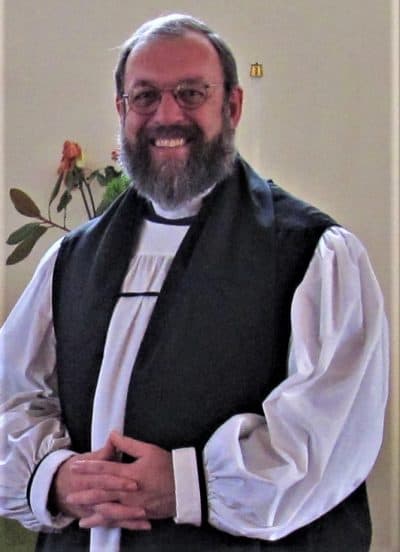
The Most Rev. Peter D. Robinson is the Presiding Bishop of the United Episcopal Church of North America. He also serves as ordinary of the Missionary Diocese of the East and rector of Good Shepherd Anglican Church in Waynesboro, Virginia.
Footnotes
- 1
E. H. Browne, An Exposition of the Thirty-nine Articles: Historical and Doctrinal, 12th Ed. (Longmans, Green & Co., 1882). - 2
E. Cox, ed. Writings and Disputations of Thomas Cranmer Relative to the Sacrament of the Lord’s Supper (Cambridge University Press, 1844), 450.