Communion by Declaration
The confessional turn of orthodox Anglicanism and the emerging division of Anglicanism.
By The Right Rev. Kevin Francis Donlon, Assistant Bishop of Zanzibar and Episcopal Vicar of the Anglican Union for the Propagation of the Gospel, an international ministry of ortatories.
Introduction: From Crisis of Authority to Ecclesial Division
With the conclusion of the 2026 Global Anglican Future Conference (GAFCON) summit in Abuja, Nigeria, a new vocabulary has entered Anglican discourse. Among the most prominent terms is “ conciliar.” Many Anglicans assume the term refers simply to governance through councils rather than through a single hierarch. While this captures part of the meaning, it does not adequately describe the deeper ecclesiological implications now unfolding within global Anglicanism.
Historically, Anglicanism adapted ideas from the medieval conciliar tradition, transforming fifteenth-century principles of ecclesial consultation into a distinctive model of church governance. The Anglican Communion rejected centralized juridical authority while maintaining unity through episcopal fellowship, shared liturgy, and consultation among autonomous churches.[1]
Yet this model depended upon a delicate equilibrium: autonomy held in tension with communion. Anglican provinces retained independence, but they also recognized a shared identity expressed through the Lambeth Conference, the Anglican Consultative Council, and the symbolic primacy of the Archbishop of Canterbury. That balance is now under unprecedented strain.
The present Anglican crisis is often described as a conflict over doctrine, particularly in matters of human sexuality and holy orders. Yet the deeper issue is ecclesiological. Anglicanism now faces a crisis not merely of theology, but of authority, governance, and identity.
What began as disagreement within a communion is increasingly becoming the formation of parallel ecclesial structures, suggesting that Anglicanism may be moving from internal conflict toward a structural division of communions.
I. The Anglican Adaptation of Conciliarity
Unlike the centralized authority structures of the Roman Catholic Church, the Church of England rejected the idea of universal juridical authority vested in a single office. Instead, the English Reformation produced a distinctive ecclesiology balancing royal supremacy, episcopal oversight, and theological discernment.
Article XXXVII of the Thirty-Nine Articles affirms the monarch’s authority in ecclesiastical matters within England, yet Anglican theology gradually articulated a broader framework often described as dispersed authority.[2]
In this model authority is shared among several sources:
- Scripture
- Tradition
- Reason
- The consensus of the faithful
The English Reformation invoked conciliarist logic to justify its break from Rome. The 39 Articles of Religion state in Article XXI: “ General Councils... when they be gathered together (forasmuch as they be an assembly of men, whereof all be not governed with the Spirit and Word of God) they may err, and sometimes have erred...” [3]
By acknowledging that even councils can err, Anglicans took the conciliar principles from the 15 th Century a step further*: Scripture* is the ultimate authority, and councils are the necessary, though fallible, tools for interpreting it. This pattern with Scripture holding Primacy became an Anglican Quadrilateral which promoted a “via media” (middle way), fostering a communion of autonomous dioceses in the Church of England and ultimately autonomous provinces in the Anglican Communion rather than a top-down hierarchy.
As for the Archbishop of Canterbury in England, he held a Primacy of Honor which globally on the Communion was to be moral influence but no juridical jurisdiction beyond his diocese, not to mention the provinces of the Communion. In this way Anglicanism evolved without a centralized magisterium while still preserving catholic order.
The role of the Archbishop of Canterbury emerged within this structure as a symbolic center of unity rather than a juridical authority. Lambeth Conference resolutions repeatedly affirmed this limited role. For example:
- Lambeth 1888 authorized the Archbishop to appoint ecumenical committees
- Lambeth 1930 described the Archbishop as “the center of unity” for the Communion
- Lambeth 1968 recognized the Archbishop’s relationship with the Anglican Consultative Council
- Lambeth 1978 affirmed his role in convening bishops for consultation and fellowship [4]
These resolutions demonstrate that the archbishop’s authority within the Communion is moral and relational rather than canonical. The Anglican Communion thus developed as a fellowship of autonomous provinces bound together by bonds of affection rather than legal jurisdiction. For nearly 150 years this evolving ecclesiology sustained remarkable global growth. Yet its did so with a weakened structure or what many call an ecclesial deficit of Anglicanism, where autonomy and dispersed authority are ever-evolving variables not rooted in a canonical or conciliar series of norms.
II. Conciliarity and the Doctrine of Necessity
The Anglican understanding of conciliarity emerged in conversation with earlier debates within the medieval church. Conciliarism developed during the Great Western Schism (1378–1417) when multiple claimants to the papacy divided Western Christendom.
Canon law traditionally maintained that the Pope could be judged by no one (Prima Sedes a nemine iudicatur).[5] Yet conciliar theorists argued that extraordinary crises justified extraordinary remedies. In situations where the unity of the Church itself was threatened, a council representing the wider church could act to restore order. This reasoning became known as the Doctrine of Necessity.
The most famous example was the Council of Constance, which resolved the papal schism by deposing rival claimants and electing a new pope. Conciliar theory therefore asserted a crucial principle: When ordinary structures fail*, the Church may create extraordinary mechanisms to preserve its unity and faith.*[6]
It is precisely this logic that appears to animate the recent actions of GAFCON because in March 2026 GAFCON announced the creation of a Global Anglican Council (GAC) intended to provide leadership for Anglicans who believe the traditional Instruments of Communion no longer protect the faith.[7] The initiative seems to draw inspiration from the Global South Fellowship of Anglican Churches Cairo Covenant, which proposed a new conciliar structure for global Anglican leadership. These two bodies met in Kigali in April of 2023 and discussed the merits of a variety of proposal to restore orthodoxy within the Anglican Communion.[8]
GAFCON leaders argue that these structures are necessary because the existing instruments of communion have lost credibility. But are the instruments of Communion even conciliar? Historically councils were legitimate precisely because they represented the entire church. For example, even The Council of Constance gathered supporters of all rival popes in order to restore unity. By contrast, the Global Anglican Council represents only one portion of Anglicanism as it seeks to represent Anglicans worldwide who identify with what GAFCON calls “orthodox” or “confessing” Anglicanism, particularly those who ascribe to the Jerusalem Declaration (2008) and the broader of Confessing Anglicans.
Thus, what is presented as conciliar reform may instead mark the emergence of parallel ecclesial authority.
III. Two Councils, Two Visions of Anglican Authority
The Anglican Consultative Council (ACC) has long functioned as one of the four historic Instruments of Communion. Created by the Lambeth Conference in 1968, it gathers bishops, clergy, and lay representatives from across the Anglican world for consultation and cooperation. Its authority is deliberately limited. The ACC does not legislate for provinces but instead encourages collaboration in mission and ecumenical dialogue.
The Global Anglican Council represents a fundamentally different approach.Formed by GAFCON in 2026, the GAC seeks to function as a governing council for those provinces aligned with the Jerusalem Declaration.
This creates two parallel structures:
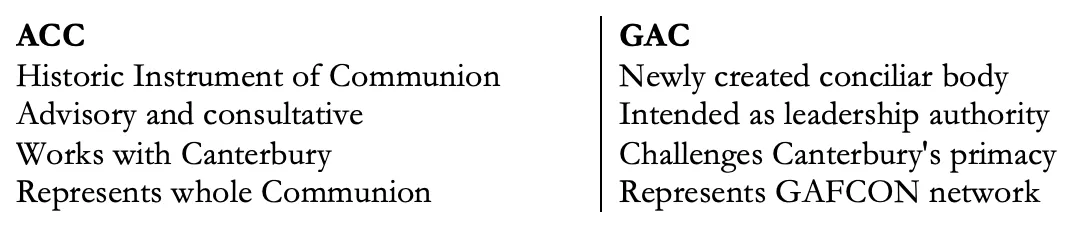
These councils embody two competing ecclesiologies. The ACC represents the historic Anglican preference for consultation without coercion. The GAC represents an emerging model of confessional Anglicanism.
IV. The Problem of Conciliar Legitimacy
Conciliar authority historically depended upon universality.[9] A council derived legitimacy from representing the entire Church, including those with whom one disagreed. The Council of Constance succeeded because it included supporters of all rival papal claimants. Neither Lambeth nor GAFCON nor the Global South Fellowship currently meets this standard. In the case of the Lambeth Conference, it lacks universal participation due to theological disagreements. Similarly, GAFCON gatherings intentionally include only those who subscribe to the Jerusalem Declaration, the Kigali Commitment and now the Abuja Affirmation. While the Global South Fellowship does have overlap of members not all members ascribe to the Jerusalem Declaration, but all members are required to assent to the “Cairo Covenant 2019” and the “Ash Wednesday 2023 Declaration, this creating its own criteria for exclusions.
In classical canonical terminology, a council that excludes significant portions of the Church risks becoming a conciliabulum —an assembly lacking universal authority.[10]
This raises a critical question: Is the Global Anglican Council a legitimate conciliar body or simply a confessional alliance of like-minded churches? Moreover, how can any of these leading Anglican expressions—irrespective of its orthodox claims—contend they are authentically conciliar? Despite claims to conciliarity, GAFCON has offered a “parallel framework” or called to lead a “reforming movement”. Furthermore, there has been a distinction between GAFCON (a movement) and the Global South Fellowship of Anglicans (GSFA), which has more established covenantal structures. In both cases there is dissonance and consonance with the Anglican Communion. It seems that all three Anglican bodies (GAFCON, ACC and GLOBAL SOUTH) have an approach to “conciliarity” which appears to be a form of “rule by committee” without canonical foundations.
This divisive Communion risks transforming the Anglican Idea from a communion defined by its own Quadrilateral into a fellowship defined primarily by confessional alignment. The question emerges: what happens to the theological traditions of Orthodox Anglicans that do not fit neatly within the Jerusalem Declaration’s Cairo Covenant framework? Anglo-Catholic theology, with its emphasis on sacramental realism and patristic continuity, may find itself in tension with the Declaration’s more Protestant-leaning formulations. Similarly, the Broad-Church Prayer Book tradition, which has historically valued theological reflection and intellectual charisms, faces pressure to conform to a confessional standard.
V. Canonical Chaos: Overlapping Jurisdictions
The Anglican Communion has long navigated the tension between local autonomy and global unity, yet the rise of parallel jurisdictions represents a fundamental rupture in its ecclesiological fabric. Historically, the church operated under the ancient canonical principle of una sedes, unus episcopus —one bishop in one territory. This geographical exclusivity was not merely administrative; it was a theological safeguard designed to preserve the visible unity of the Church. Within a defined diocese, the bishop served as the singular focal point of apostolic succession and sacramental authority, ensuring that the faithful could identify a clear locus of communion.
However, the contemporary landscape of Anglicanism has seen a dramatic departure from this norm,[11] driven largely by the Global Anglican Future Conference (GAFCON). In response to perceived doctrinal drift within the historic provinces of the Communion, GAFCON has authorized the establishment of missionary dioceses and even entire provinces within territories where established Anglican structures already exist. This phenomenon is particularly evident in North America and Europe, regions that have long been the heartlands of the Anglican tradition. By planting new jurisdictions in these spaces, GAFCON has effectively created a system of overlapping authorities, where multiple bishops claim legitimate oversight over the same geographic and spiritual population.
The canonical consequences of this proliferation are profound and destabilizing. The traditional ecclesial map, once defined by clear territorial boundaries, has become a palimpsest of competing claims. This creates an immediate crisis of legibility for the wider Christian world.
Ecumenical partners—from the Roman Catholic Church to the Orthodox communions and Lutheran federations—have historically sought dialogue with “the Anglican bishop” of a given region, operating on the assumption that a single representative embodied the province’s stance. Today, that assumption no longer holds. Instead of a unified voice, ecumenical interlocutors encounter a cacophony of competing claimants, each asserting apostolic legitimacy and doctrinal fidelity. This multiplicity renders the concept of a unified Anglican witness increasingly difficult to sustain, as the “one bishop” model essential for clear diplomatic and sacramental engagement has fractured.
More than a mere administrative inconvenience, the emergence of these parallel jurisdictions signals a deeper fragmentation of Anglican ecclesial identity. It suggests that the Communion can no longer rely on geography to define its boundaries or its unity. When authority is no longer tied to a specific territory but is instead claimed by transnational movements based on doctrinal alignment, the very nature of the church shifts from a visible, localized community to an invisible network of ideological affinities. This shift challenges the classical understanding of the church as a visible body united in space and time.
Ultimately, the proliferation of parallel jurisdictions indicates that the Anglican Communion is grappling with an existential crisis of identity. The move away from the principle of one bishop per territory does not simply reflect a disagreement over theology or liturgy; it represents a fundamental reimagining of what constitutes the Church. If the visible unity of the Church is to be maintained, the Communion must confront the reality that its current trajectory toward fragmented, overlapping jurisdictions may render the concept of a single, coherent Anglican identity obsolete. The challenge ahead is not merely to manage these competing claims, but to determine whether a church can remain truly “catholic”— universal and whole—when its very structure is built upon the foundation of division that stems from its great ecclesial deficit which is the primacy of autonomy within Anglicanism.[12]
V. The Confessional Turn in Anglican Identity
Traditional Anglican ecclesiology operated on a distinctive principle: unity through liturgy rather than uniformity through doctrine. The Thirty-Nine Articles, drafted during the English Reformation, were never intended as exhaustive confessional standards but rather as boundary markers against specific theological errors. Anglican identity emerged organically from shared worship patterns, the rhythm of the Daily Office, and participation in the sacraments under episcopal oversight.
This approach allowed for considerable theological diversity within the Communion— Evangelicals, Anglo-Catholics, and Broad-Church parties could coexist precisely because the binding element was not doctrinal precision but liturgical and sacramental communion.
GAFCON’s elevation of the Jerusalem Declaration to primary criterion of belonging as an Orthodox Anglican signals a fundamental reorientation. The Anglican Idea no longer depends on participation in a shared liturgical tradition and more on explicit subscription to specific doctrinal formulations of the undivided church.[13] This confessional turn mirrors the approach of continental Reformed traditions more closely than the historic Anglican way of the Quadrilateral.
The tragedy and the opportunity of this moment lie in the realization that the Anglican identity is no longer a monolith. It has split into two distinct trajectories, each claiming the mantle of orthodoxy and authenticity. The future of Anglicanism will not be defined by how well these two visions can be reconciled, but by how clearly they can define themselves against one another, and whether the world is ready to accept that there may no longer be “one Anglican Church,” but rather two competing heirs to the Reformation legacy.
Moreover, this chasm creates challenges for the ecumenical relationships that Anglicanism has cultivated over centuries. Partners in dialogue with Roman Catholics, Orthodox, and other Protestant communions have historically engaged with Anglicanism as a liturgical and episcopal tradition. A confessional redefinition complicates these relationships, as ecumenical partners must now navigate multiple competing claims to Anglican authenticity based on doctrinal subscription rather than visible communion.[14]
Conclusion: Finding a Narrow Path Between Two Extremes
In 1999, Bishop Chuck Murphy of the Province of Rwanda articulated that within Anglicanism, there was a crisis of faith and a crisis of leadership.Certainly, the early members of GAFCON Leadership heard that cry, namely Archbishops such as Akinola, Kolini, Nzimbi, and Orombi. The substrata of that cris was the crisis of ecclesiology and canonicity. Many hoped the crisis would pass because Anglicanism had traditionally been a “big tent” held together by the Book of Common Prayer rather than a strict confession of faith along with Common Principles such as the Lambeth Quadrilateral.
By insisting that every participant assent to that document, GAFCON has effectively turned a theological confession into a gatekeeping instrument—much as the historic Reformed confessions did for Presbyterianism. The declaration’s strict adherence to a particular doctrinal line has, in practice, produced a new orthodoxy that many Anglicans cannot comfortably inhabit.
For orthodox Anglicans whose sense of identity rests on the historic liturgy, the episcopal succession, and the breadth of the Anglican quadrilateral (Scripture, Tradition, Reason, and the consensus of the faithful), the GAFCON framework is often too narrow. Its interpretation of secondary matters (adiaphora) excludes the theological latitude that Anglo-Catholics and prayer-book evangelicals have traditionally enjoyed. By defining belonging primarily through a single declaration rather than through lived communion, GAFCON risks internal fragmentation—the very disunity it claims to remedy.
At the same time, the liberal trajectory represented by the current Archbishop of Canterbury offers little consolation to these same orthodox believers. The Archbishop’s emphasis on inclusive language, progressive ethics, and broader ecumenical openness runs counter to the confessional rigor demanded by GAFCON, leaving a substantial segment of the Communion—those who value both historic catholicity and disciplined orthodoxy —without a clear institutional home.
Consequently, orthodox Anglicans, both Anglo Catholics and Prayer Book Evangelicals, find themselves caught between two poles:
• GAFCON’s confessional exclusivity – a rigid doctrinal filter that marginalizes nuanced theological expression.
• The archbishop’s liberal reforms – a pastoral agenda that dilutes the doctrinal boundaries many orthodox Anglicans deem essential.
Both poles undermine the collegial, dispersed authority that the Anglican Communion historically prized. Rather than moving toward genuine collegiality—a shared governance model where bishops, clergy, and laity cooperate in mutual accountability—these divergent trajectories deepen the identity crisis for those who wish to remain faithful to the historic Anglican heritage while also seeking a coherent, canonically consistent communion.
Until a renewed mechanism of mutual recognition and balanced synodality emerges—one that honors the historic episcopate, respects the breadth of the Anglican quadrilateral, and allows space for both confessional conviction and diverse churchmanship—orthodox Anglicans will continue to navigate a fragmented landscape, praying that the promise of “autonomy within communion” can be realized without forcing them to choose between GAFCON’s narrow confessionalism and the Archbishop’s liberal orientation and taking another path altogether different.
The future of Anglicanism may depend upon whether these competing visions can be reconciled—or whether Anglicanism is already entering a new era as a family of divided churches rather than a single global communion.
Cf. M. Chapman and P. Avis. The Oxford Handbook of Ecclesiology. Oxford University Press, 2018**,** pp. 250–310. ↩︎
Russell Dewhurst. Synodality at the universal level in the Anglican Communion. Ecclesiastical Law Journal, Volume 27, Issue 2. May 2025, pp. 170 - 172 ↩︎
39 Articles, Art. XXI, from: The Book of Common Prayer, Cambridge: Cambridge University Press, 2000, 1662 edition. ↩︎
Lambeth Conference Resolutions, 1888–1978. Anglican Communion Office, https://www.anglicancommunion.org/resources/document-library.aspx?author=Lambeth+Conference ↩︎
Robert Somerville. Papacy, Councils and Canon Law in the 11th–12th Centuries. Routledge, 1990, pp. 33-50 ↩︎
March 5, 2026 GAFCON press release announcing the GAC, https://gafcon.org/communique-updates/a-council-to-lead-the-communion/ (accessed 5 Mar 2026) ↩︎
Global South Fellowship of Anglican Churches Cairo Covenant, Section 3.2.3, https://cdn.prod.website-files.com/64c7520a09b851adae283880/64f6cf1ea4f7e1c49c0619c3\_GSFA Covenantal Structure (adopted on 15 Oct 2021).pdf (accessed 9 Mar 2026) ↩︎
Brian Tierney. Foundations of the Conciliar Theory. Cambridge University Press, 2010, pp. 220-238 ↩︎
Mark DeCogliano**.** The Cambridge Edition of Early Christian Writings. Cambridge University Press, 2022, pp. 658 - 717. ↩︎
Duane Miller. Mission and Disintegration in Global Anglicanism from the 1960s through 2022: An Update to Stephen Neill’s Anglicanism. Global Missiology, www.globalmissiology.org, January 2023. ↩︎
Paul Valliere. Conciliarism: A History of Decision-Making in the Church. Cambridge University Press, 2012, Chap. 4. ↩︎
Arthur Middleton.Restoring the Anglican Mind. Gracewing, 2008, pp. 32-34. ↩︎
Jonathan Luxmoore. Catholics are urged to be cautious over new Anglican schism, March 9, 2026. https://www.osvnews.com/catholics-are-urged-to-be-cautious-over-new-anglican-schism (accessed 9 March 2026) ↩︎